Çisemnaz Çil
Çisemnaz Çil is an undergraduate student in American Culture and Literature at Hacettepe University. Her work explores the intersections of experimental writing, visual media, and illegible form. She is interested in how knowledge can emerge through exhaustion, repetition, and drift—outside of clarity or closure. Drawing from slow cinema, feminist poetics, and speculative theory, she creates hybrid works that blur the line between essay and experiment. Her current project thinks with the temporal disruptions in the films of Béla Tarr and Lav Diaz, not by interpreting them, but by inhabiting their broken rhythms.
No Argument, No Arrival: A Theory of Illegible Form in the Shadow of The Turin Horse and From What Is Before
This project diverges from the traditional essay structure to embrace a scholarship of pause, stillness, and fatigue. Its methodology echoes the temporal collapse and epistemic fatigue of these films. It invokes the poethical (Ferreira da Silva and Desideri), the atmospheric (Sharpe), the exhausted (Berlant), and the non-arrival (Hui)—not to illustrate, but to vibrate alongside. In this spirit, the project also includes the construction of a small- scale experimental device designed to physically manifest temporal drift and conceptual illegibility—neither symbolic nor functional, but epistemologically resistant.
It favors flicker over analysis, saturation over clarity, and drift over authority. Quoting transforms into reverberation; framework, a gradual downfall. Drawing on failure as generative (Samuels and McGann)[1] the essay aligns with Deleuze’s “time-image”[2] and Agamben’s “hollow form”[3]to trouble the idea of academic legibility itself. This is not a paper. It is a failed structure, a cinematic residue, and a device that refuses to explain. In doing so, it aligns itself with a cinematic lineage that privileges duration over development, fragment over thesis, and residue over representation.
The Turin Horse: Nietzschean Collapse and the Ethics of Fatigue
Béla Tarr begins The Turin Horse by showing affliction rather than any kind of action. The film presents wind-blown dust alongside a man who fights to control a horse as its initial image which represents an existential condition more than explanatory information. Time has not caused this decay because decay represents its fundamental essence. The Nietzschean elements according to Stellino dominate this work because the film establishes Nietzschean thinking as an integral part of its cinematic space that affects all actions and empty spaces.[4] Bernhard represents a Nietzschean figure to Tarr who speaks through monologues that echo Nietzsche’s famous phrase “God is dead.”[5] The Nietzschean concept runs deeper than decoration because it establishes the structure of the entire work.
Tarr creates a film structure that lacks any form of metaphysical relief. The Turin Horse depicts the “weariness of man” through images and rhythms and through a deliberate refusal which Nietzsche wrote about.[6] The film demonstrates the global entropy that affects its characters according to Stellino through its cinematic presentation of the daily routine that includes dressing and eating and undressing and sleeping.[7] The horse refuses to move. The daughter ceases to speak. The fire dies. The characters express their surrender through real-life actions which demonstrate the complete disappearance of meaning in a world where God is already dead.
Tarr’s formal decisions in the film demonstrate the same process of deterioration. The combination of long takes and minimalist mise-en-scène with monochromatic cinematography serves as structural metaphysical representation. The camera of Tarr maintains a state of endurance instead of observation. Every motionless frame allows disorder to build up through time. The early sequence of the film follows Ohlsdorfer and his daughter through their silent potato-boiling and eating process. The film presents a meal without narrative progression that advances character development or plot progression yet it remains purposeful. The cinematic realization of Nietzschean “eternal return” presents itself as a permanent state rather than a heroic declaration about life.[8] The world of Tarr shows life returning not to restore itself but to rot away.
The film presents a circular structure as Stellino observes which leads the viewer to participate in the repeating cycle of violence through its infinite and continuous nature. The Turin Horse exhibits similar characteristics to this observation, although its violence unfolds at a slower pace that resembles geological processes.
The house falling apart, the lights dimming, and the silence growing deeper—these are signs of abandonment, a universe that no longer recognizes its inhabitants. But the viewer isn’t let off the hook, either. The long, uncut shots draw you into this stillness; the camera stays on one scene because there’s nothing left to see next. In The Turin Horse, Nietzsche’s ideas aren’t just stuck in Bernhard’s speeches—they’re woven into everything. Bernhard shows up on the second day asking for pálinka, and he offers a monologue that sounds like the madman from The Gay Science, the one who proclaims that God is dead. But it’s beyond a passing reference; the scene itself is acting out that idea. Bernhard speaks calmly, without urgency or despair, revealing a world where God has disappeared, but no new order has taken its place. His voice feels detached, almost beyond human. Tarr points out that it’s not just Bernhard who is Nietzschean—it’s the whole world, a world that has outlived both God and humanity. All together, Stellino describes how the film shows “the disappearance of any divine, human, or natural order”.[9] The horse refusing to eat, the well going dry, the wind howling louder—these all hint at a larger cosmic withdrawal. In this universe, the will to power no longer makes sense; now it’s just about hanging on and going through the motions until even those stop working. The film ends not with a big climax, but with complete darkness and silence. It’s not symbolic—it’s final. Every aspect—visuals, themes, philosophy—falls into a shared atmosphere of exhaustion. And in that fall, Tarr doesn’t offer a message, just an experience. An experience of the end—not as a disaster, but as a continuation.
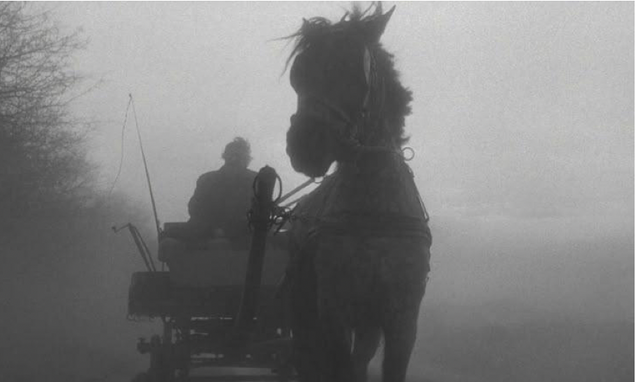
Figure 1 Still from Béla Tarr’s The Turin Horse (2011). The horse’s inertia is not resistance but resignation: the cinematic embodiment of metaphysical exhaustion.
the horse doesn’t move—
it refuses.
Viewed within the context of Gilles Deleuze’s theories regarding the movement-image and the time-image, the film offers itself not so much as a visual narrative in and of itself but rather as an ontological arena where in time itself becomes the object of scrutiny. In Deleuze’s schema, the movement-image is defined by logical progression and sensory-motor connections between action and reaction.[10] In explaining Béla Tarr’s cinema, he says, “I despise stories, because they deceive as if something has happened; in fact, nothing happens… what remains is time.”[11] The same applies to ”The Turin Horse”. The attempt of the characters to change their situations always proves to be in vain; the outcome may even be worse than the initial situation. This inability to progress dispenses with the illusion of causality and linear time, and offers the viewer not the chronology of happenings, but the continuum of “lived time” — typically vacant and full of waiting. Tarr’s glacial long takes, together with repetition and circularity, find visual expression for Nietzsche’s theory of “eternal return.”[12]
“There is no change. There is no change. There is no change,”
says Ohlsdorfer to his daughter.
No change is change.
The potato is eaten again.
In half. Again.
The man drinks again.
The horse doesn’t move.
And silence, again and again.
This cyclical stasis—
this stagnation—is not quite nihilism, [13]
Or maybe it is.
But softer, wider and thicker
It is not the void,
but the eternal drag of becoming void.
It is collapse
as duration.
as fatigue.[14]
Not as destruction—
not as shatter,
but as decay,
as a molasses-thick erosion of being.
Over.
And over.
Collapse as a ritual.
Collapse as form.
Form folding in on itself.
Form repeating form until form becomes content.
Time, too, caves in.
Time stretches.
And thickens.
To unbearable stasis.
There is no climax, [15]
No eruption, no arrival.
Just duration, just waiting.
And Tarr—Tarr makes you wait. [16]
He makes you stay.
He makes you watch.
He makes you walk.
He makes you return.
To the same shots.
To the same gestures.
To the same objects.
And there is no escaping it.
You cannot skip this.
You cannot fast-forward.
You cannot leave the room.
Stay in it.
In boredom and slowness.
Because in that staying—
in that breathless, endless staying—
something happens.
And maybe, just maybe—
That is the change.[17]
not the shift itself,
but noticing.
Deleuze sees cinema as a place where we can rethink our relation to the world. Tarr, however, employs cinema to illustrate the breakdown of that relation. In The Turin Horse, nature is no longer a locus of care. Instead, it is a hostile, speechless presence. The incessant wind that screams throughout the film is an implacable force from without—a non-mysterious sound, a climate devoid of narrative purpose. Here, nature is not a setting, but a conscious, relentless force.[18]
The most powerful example of this broken link comes when the horse—usually a symbol of motion and power—will not eat, move, or even acknowledge its owners. This is not just the exhaustion of an animal; it is the physical embodiment of breakdown. The immobility of the horse mirrors the existential inertia that has permeated the human characters. In the framework of Deleuzean theory, the horse is no longer an actor in a movement-image but rather an object in suspended time. [19]

Figure 2 Frame from The Turin Horse (2011). A moment of “cruel optimism” (Berlant, 2011), where the gesture toward illumination fails not due to accident but because of systemic entropy.
no spark.
only the trying
Deleuze’s time-image is realized in this instant. The film sheds action entirely, becoming pure duration. Instead of seeing a narrative progression, the viewer is immersed in time, implicated in a slow unwinding—a temporal implosion that will eventually give way to nothing but stasis.[20]
From What Is Before: Blackness, Haunting, and Historical Atmospheres
Similarly, From What Is Before begins with a still shot of a tranquil rural landscape, graced by a caption that states, “Philippines, 1970.” A grave voice-over emerges, revealing to the viewer that the narrative is inspired by memory and that the characters are rooted in reality. From the very beginning, the film sets a tone of mourning and ominous anticipation. During the opening hour, the camera holds steadfastly still, filming the texture of life in a distant barrio in a succession of lengthily-held extreme long shots. The characters attend to their daily business—caring for animals, hauling water, or conducting traditional healing rituals—with minimal speaking. The wind sound prevails, blowing incessantly and, coupled with the stark black-and-white visuals, building a growing sense of tension that mounts unrelentingly to the film’s emotionally draining conclusion.
The film subtly suggests the passing of time through minimalist intertitles. The figure “1971” appears behind the flames of a burning building, signaling a dramatic break. Following it is a chain of intensifying violence—a slaughtered pig is found, additional houses are torched, and a sense of terror and suspicion pervades the community. When the screen flashes to “1972,” those familiar with Philippine history will immediately catch the allusion to the imposition of martial law, that watershed event that ushered in a decade saturated with authoritarianism and state violence. It is from this point on that the tenuous web of community starts to unravel entirely. The military enters the scene, the barrio is evacuated, and those left behind are plunged into a deep moral and existential crisis.
A key point of resonance is Chris Marker’s Letter from Marker, a text that, while nominally structured as a voice-over travelogue, undoes its own narrative claims through disorientation, drift, and poetics of interruption. As Marker explains, “I’ve committed myself to drift in all directions.”[21] This commitment to drift—to dislocation as methodology— rejects the presumed authority of both the academic voice and the filmic narrator. The drift becomes epistemological: a means of resisting the rigid frames of knowledge-production that demand linearity, resolution, and self-containment. The present work echoes Marker’s gesture by refusing to complete itself. Like Marker’s narrator, it dwells instead “in the editing that the pieces of the puzzle came together—and it wasn’t me who designed the puzzle… it just happened”.[22] Here, creation is reframed not as intentional mastery but as accidental emergence, an orientation deeply aligned with Denise Ferreira da Silva and Valentina Desideri’s call for the poethical—an approach that unlinks thinking from the totalizing demands of reason.[23]
Marker’s film resists narrativity not simply through content but through form—a form composed of fissures, silence, digression, and delay. He asserts: “Out of these juxtaposed memories is born a fictional memory. Poets are made to create such moments—moments of borrowing a strength that is not ours.”[24] Memory in Letter from Marker is thus not archival but fictional, constructed through proximity, rhythm, and resonance. This aligns with what Christina Sharpe defines as atmospheric thinking—a mode in which meaning does not arrive through clarity but circulates like weather: diffuse, shifting, affective. In similar fashion, the present essay gathers “theoretical aftershocks” not to explain but to vibrate.[25] As Sharpe insists, thinking from within the wake of historical and structural violence requires aesthetic modes attuned to weather, rupture, and resonance, rather than certainty or conclusion.
This methodology, grounded in temporal resistance, is also informed by Deleuze’s concept of the time-image, which Marker’s film embodies in its refusal to subordinate time to action. “The real glance… lasted a twenty-fourth of a second, the length of a film frame,” Marker notes.[26] This microscopic measure of duration—a unit so small it borders on invisibility—highlights cinema’s ability to capture the fleeting and the unfinished. It is this durational quality, this insistence on being with time rather than in time, that also defines the essay’s affective pulse. Rather than illustrate theory, the essay flickers alongside it—insisting on what Deleuze would call a cinema of the in-between. In material terms, the project extends this refusal of resolution into the physical world by including a hand-built experimental device. This device is not symbolic, nor strictly functional; rather, it is a material trace of temporal illegibility. It exists as an object that resists instrumentalization, echoing what Yuk Hui identifies as the non-arrival of meaning in the digital age. It does not “perform” interpretation—it merely drifts, resonates, and resists. Its presence within the project mimics Marker’s own montage of “images gathered, images created, together with some images borrowed,” constituting a kind of epistemological noise rather than legible argument.[27] For instance, Diaz’s camera, a poethical sensorium that does not document but receive, touches the world with an haptic, somatic listening that refuses the logic of mastery, such that the land and its denizens may, in their own durations, speak.
Furthermore, the piece interrogates the authority of academic language itself. Marker’s disavowal of voice-over mastery is revealing: “This work in no way constitutes an autobiography… All I have to offer is myself.”[28] The gesture here is not confessional but ambient—a withdrawal from both interpretive dominance and analytical overreach. This mirrors Lauren Berlant’s articulation of cruel optimism, where the desire for clarity and progression itself becomes toxic. To write from exhaustion—to remain with the delay, the silence, the refusal—is thus not a failure of rigor but a refusal of cruelty.[29]
This is why the present work does not cite so much as echo. It does not analyze so much as flicker. It does not aim for truth, but for vibration. In this sense, the essay is not a document but a residue—a hollowed-out form in the Agambenian sense, whose purpose is not to convey meaning but to trouble the very conditions of legibility.[30] The structure failed, not accidentally but generatively—aligned with Eve Kosofsky Sedgwick’s call for reparative reading and Jack Halberstam’s queer embrace of failure as method.[31] Ultimately, as Marker writes: “My memory should serve as a springboard for [the visitor’s] own pilgrimage in time regained”.[32] This work offers the same—a landscape of conceptual ruins, a space for readers not to interpret, but to inhabit.
The internal entanglement will be helpful in the exploration for a multidimensional understanding of the complex interplay of materiality and meaning, especially with cinema as the medium through which it explores meanings: spee-ph. That is to say, significations are best understood as the coalignment of cinematic features—political representations where lighting, mise-en-scene, and narrative flow converge in synthesis to articulate meaning. Not merely a representation of reality, the cinema is a material-discursive system that commands active shaping and transformation from the very constituting elements of its form itself of the audience’s interpretations.
This entanglement occurs dramatically in nearly all cases through the means of visual beauty. Cinematography, lighting, and even mise- en-scene would be examples in this category. Shadows and light conflict with each other as double-edged themes—good and evil, consciousness and unconsciousness—with extremely tenuous undertones of meaning far beyond the literal narrative. These manipulations emotionally stimulate, providing directions on how we build other people and others in our thought narratives. Visual treatments language-specific also show how certain of these style options are not random but material in meaning construction. Such is the implication of genre theory.
Deformance, Refusal, and the Ethics of Form
In fact, this process of entanglement resonates quite profoundly with the theoretical framework provided by Karen Barad theorizing many conditions of agential realism, which claim that matter and meaning are not separate elements, but rather intra-actively co-constituted.[33] Barad’s concept of entanglement thus dismantles the dichotomy between representational and material, positing instead that all phenomena, including film, emerge from particular intra-actions that bring the world into being differently. This really makes the film not a passive holder of ideas, but an active participant in world-making.[34]
And proudly so, the site where all this happens is exactly the intersectionality of aesthetics, narrative, and theme into the film medium ontology entanglement of matter and meaning. Borrowing from Barad’s insights, we see cinema as a generative apparatus through which meaning does not solely arise from representation but from the intra-action of its material-discursive elements. Cinema, thus, is made not just a world-mirror but a place where new worlds can always be constructed and unmade.
Lav Diaz’s ‘From What Is Before’ (2014) conveys a case of Blackness abstraction beyond racial identity into one that is philosophical, atmospheric, and ontological. With chiaroscuro lighting, extremely long takes, and no color, the film appears phenomenologically engaging with Blackness—not as skin but as condition, space, and silence. “Blackness” here becomes synonymous with Christina Sharpe’s “the wake,” which construes blackness as a sort of present absence, the shadow cast by colonial trauma and existential despair that cannot be avoided.[35]
One of the most impressive sequences in the film sees the camera lingering for more than five minutes over an unlit corridor in the church of this village, where only distant sounds-animal cries, whispers, the wind-hints at movement. This overwhelming darkness negates visual consumption and gestures towards what bell hooks has qualified as “the oppositional gaze,” whereby viewers must learn to see beyond conventional legibility.[36] By withholding light, Diaz renders Blackness meaningfully not absence but something too full, too dense to be perceived.
More than the setting, Diaz’s rural Philippines becomes, like those postcolonial landscapes by Akomfrah, an actor in the narrative. Fortress-like against the sky, the land becomes a haunted archive of colonial and fascist violence. Sluggish, circular chores are reiterated by the characters and mirror the kind of temporality the French psychiatrist Frantz Fanon described with regard to the colonized subject-a time without future, stuck in repetition, negation, and erasure .[37]
Black witness occasions are provided by the long, static scenes where characters are sepulchered in darkness—the village elder talking about Americans and mysterious disappearances. These figures do not articulate trauma like the protagonists of Barry Jenkins’s Moonlight, yet they carry it with them, in silence. That silence, framed by Blackness, can be counter-discourse to the dominant prevailing histories: an act of resistance encoded in absence. Blackness, in Diaz’s film, does not only represent what it is before, but definitely what that continues to haunt long after; what remains unassimilable by the nation-state, by the viewer, or by time itself.
Like Ferreira da Silva and Desideri’s poethical framework, Lav Diaz’s cinema enacts a profound suspension of the individuated, self-possessed subject. Instead of situating agency within a coherent protagonist or a psychologically legible narrative arc, Diaz disperses subjectivity across landscapes, silences, temporal delays, and spectral presences. In From What Is Before, for instance, the camera will often linger on empty spaces, abandoned roads, or weather phenomena,welcoming spectators into a mood of circumstances rather than an interiority of character.These extended, static images destroy the divisions between bodies, recollections, and environments and create an ontological shared space in which agency is relational, ambient, and often unseen. In this light, subjectivity is reframed as a spectral configuration shaped by affective atmospheres and colonial residues—a conceptual shift that aligns with poethical refusals of ontological closure. [38]
This dispersal doubles the poethical call for “ethics with/out the subject,” wherein ethical possibility no longer issues from reason-grounded decision-making or moral coherence but from being-in-relation: to be capable of affecting and being affected without mastery and full knowledge. Diaz’s disavowal of plot-driven narrative forms—his use of elliptical temporality, long durée, and dissolution of narrative—is also a formal challenge to Western, teleological historiography. History here is not a rolling arc of evolution but recursive hauntology, a haunt of returns, absences, and silences. This accords with the notion of Blackness as totality that exceeds identity, temporality, and representation—a Blackness that, in the words of Sharpe, “animates the atmospheric conditions of existence itself.”[39]
In this regard, the film performs what Ferreira da Silva and Desideri describe as an “imaginary without separation,” where the poetic and the ethical are not successive trajectories but coextensive modes of sensing and being. The cinema experience is now a poethical one: to look is not to know, but to linger with the ungraspable, the lingering, and the unsettled.[40]
In this sense, From What Is Before is not merely about the representation of Blackness but about a performance of this Blackness. It puts on stage the effort of looking at what resists being seen, sitting uncomfortably with it, and acknowledging that not all suffering can—and should—be translated into light. Thus, Diaz’s aesthetic converges with current Black radical thought in cinema whose focus is not representation as such, but rather on the politics of opacity, trauma, and refusal.
The phrases “cows bleeding to death” and “children screaming at night” are not narrative intensifications but atmospheric ruptures. They disrupt the continuity of rural life with signs that are not closed off and made sense of. This is the poethical place Ferreira da Silva and Desideri call upon—a space where signs do not signify but vibrate. Violence here is not a thing of knowledge but as a vibrating presence that resists closure. As the text intimates, “The village is silenced not by sudden trauma, but by slow suffocation.”[41]
Diaz’s formal practice comes after Tarr’s in its long takes, silence, repetition, and degeneration. Yet while Tarr’s universe implodes into a metaphysical void, Diaz’s landscape is stalked by the spectres of colonial memory and state violence. Both filmmakers refuse, however, to deliver catharsis. From What Is Before‘s long shots do not elucidate but obscure. As Sharpe would say, they establish an “atmospheric hold” that compels the spectator into a “haunted proximity” instead of understanding.[42]
The utilization of the narrator—a voice both participant and specter—serves to be an additional complication of this complexity. It does not attempt to interpret; it is rather beside the story. The narrator passively navigates time, echoing the audience’s own passive observation. This form of narration is not intended for comprehension; it is rather a residue. We are therefore left with texture, duration, and what Berlant would term “cruel optimism”: the expectation that resolution will materialize, even as all else deteriorates.[43]
In addition, the idea of “arrival” is undone. Martial law “arrives,” yet it’s always already here. People in the village don’t fight back; they collapse, evaporate. In this, Diaz is aligned with Yuk Hui’s philosophy of the “non-arrival” of history. History here is not a progressive narrative but a cycle of irretrievable loss. As the text reads, “The land remembers even as the people forget.”[44] This is not forgetting as absence but repetition—a constant, haunted forgetting that continues to injure.
Hardt and Negri maintain that “the new communities are not bound by geographical or cultural limits, but rather are constituted by common experiences and shared goals,” which is frequently enabled by digital technology.[45] The Turin Horse, however, presents a world where the universe is not characterized by communication with others but by deep solitude. From the initial act on, the routine of the day—fetching in water, dressing, eating boiled potatoes for lunch—between father and daughter is survival-oriented, not relational.
Outdoors, wind and the rare visitor are all that substitute for what otherwise is inhospitable, rather than relational, space. There is no shared narrative, no expanding web; geography itself repels relationality. The internal entanglement will surely grace the exploration for a multidimensional understanding of the complex materialized new range of meanings, especially the cinema, which employs it as a medium ever-intensively in the probing of such meanings: spoo-ph. This means that meanings shine ever in this perspective as configurations of motion-picture features-political representations, where their linking, lighting, mise-en-scene, and narrative flow converge in synthesis to create meaning. Rather than the representational reality, the cinema is a play system—the material-discursive-aqueduct that reshapes and transforms from the formative-kernel compounds of its very elements: the audience’s interpretations.
What must notably be underlined-notes on life-are the use of visual aesthetics in giving birth to this entanglement. Among the examples that can be taken under this category are cinematography, lighting, and mise-en-scene. Shadows and light confronting each other on the backdrop of an illustration—good and evil, consciousness and unconsciousness—are intrinsically loaded with deep, spread-out signification far beyond the mechanisms of the plot. Such manipulations are meant to incite a pathos for the identity formation of the co-inhabiting people and seen from within the narratives of their worlds. Even language-specific choices of visual stylings form yet another assertion that several of these stylistic options are rationally linked to meaning objects. This is where genre theory steps in.
Moreover, content does all the thematic work related to sociocultural thought and philosophical expression. Themes of identity, morality, and existential agony are not merely spoken of through dialogue and plot but manifest in the very performative materiality of the film itself—bodies of actors, set design, rhythm of the editing, ad infinitum. Films with social justice or ecological catastrophes function to have scenes that are actualized and shown in their materiality which elicit this affective response and challenge the moral trauma of the viewer, in turn initiating a dialog between viewpoint and textual reality in cinema.
Entaglement-Re-Interminglements resonate quite well within the theoretical work of Barad around many of the conditions of agential realism, claiming that matter and meaning are not separately but intraactively co-constituted.[46] Barad’s notion of entanglement undoes the realist/materialist polarity, suggesting instead that all phenomena, including film, spring out of a particular intertwining that brings something into being in a world. Thus, this makes the film not but a passive container of ideas, but a very active partner in world-making.
By its ontological design, this is the very spot where aesthetics and narrative themes meet to inter-twine reality with real matter, as the glue. Following Barad, cinema is thought of as a generative apparatus that gives birth to meaning through the interaction of its material-discursive elements while maintaining the apprehension that resolution of the representational onto material dichotomy be lifted. Cinema is conjured as not only being a mirror of the world, but surely a workbench for any number of worlds yet to come into being.[47]
From What Is Before does show a classic instance in the study of Blackness, a priori the Black abstraction entering into discussions surrounding race but culminating into one where the Black abstraction is purely let loose philosophically, atmospherically, and ontologically. By means of chiaroscuro lighting, what becomes phenomenologically intriguing in its encryption of Blackness is the film—without color and with hefty long takes—not really dealing in Black skin but instead taking Blackness to the condition, space, and absence of sound yet really some sort of vibration, a theory of indirect motion. Blackness here acts as an embodiment of Sharpe’s “the wake,” which considers Blackness somewhat as a present absence, as a shadow cast by colonial trauma and existential despair that cannot elude.[48]
One of the beautiful sequences in the film sees the camera lingering over a dim corridor in the church of this village for more than five minutes; only distant sounds—animal cries, whispers, the wind—suggest movement. Existing darkness negates ocular consumption and gestures to what bell hooks specifies as “the oppositional gaze,” seeing what is beyond the graphically walk-on vision.[49] By withholding light, Diaz makes Blackness, significant for something between failure and very incongruous, not an entity of absence. It is full to its logical extent, so much so that one might not perceive it.
Diaz’s rural Philippines is almost like those postcolonial terrains by Akomfrah, a force in its own right in his narrative. Full against the sky, did the land stand as an encrypted archive of colonial and fascist violence.The staggering locals are comparatively beset by those circular chores. Such a state mirrors the temporality Fanon described concerning the colonized subject-that is existence without further and stuck in repetition, in the denial, and obliteration of what went down in history.
From What is Before, even placed in the midst of a crowded Filipino barrio, similarly undermines the potential for communal experience. Villagers are introduced going about their chores in complete silence or a whisper. Even the group scenes—such as that of the villagers viewing a reenactment of a crucifixion—fail to invoke unity. Each body stands alone in its ritual, gazing not at others but into singular voids. This precisely conveys the lack of what Hardt and Negri envision as “common community.” The villagers do not come together in opposition or advancement; rather, they disperse into spectral habits, relieved of common expression.
The future society, as Buckley envisions it, will be “marked by fluidity and flexibility,” in ethical collaboration and openness rather than dogmatic socio-political structure.[50] In contrast, Tarr and Diaz show us communities not in moral flux but in stasis. In The Turin Horse, when the water stops and the horse refuses to eat, there is no problem-solving together. The daughter mutely gazes; the father drinks. Ethics do not reach out here—they collapse in on themselves. There is no reach toward mutual support, no recognition of larger responsibility. Their tiny world, instead of evolving, embraces erasure.
Similarly, in From What is Before, there are savage killings, vanishing acts, and military brutality—but everybody remains silent. The ethical breakdown is encapsulated in a pivotal scene when a child carrying a gun is seen walking guard around the village. Nobody responds. Such a scene, filled with symbolic horror, implies not moral flexibility but fear rigidity. Buckley’s “engagement premised upon a commitment to mutual well-being” is not to be found in Diaz’s terrain. The characters are afflicted with ethical atomization, and thus they are unable to build a collective response to a collective crisis.

Figure 3 Still from From What Is Before (2014). Ethical collapse is conveyed not through violence but through the haunting quietness of communal inaction (Buckley, 2017).
Whereas Hardt and Negri envision a technologically-mediated collectivity that can transcend spatial limitations, both films close off all possibility of this potential. There are no phones, screens, or digital intermediaries to be found.[51] The sole “signal” in The Turin Horse is the wind—a force that produces estrangement instead of enabling proximity. In From What is Before, all transmissibility assumes the mode of rumor and cries—acoustic soundscapes that symptomatically manifest disintegration. Consequently, the notion of globalized togetherness advocated by the theorists is rendered anachronistic, if not utopian.
Tarr and Diaz explain how vulnerable these assumptions are to material, historical, and political realities. Both films compel us to rethink the optimism of theories of “the coming community.” While Hardt and Negri and Buckley theorize community as a left-wing formation forged in ethical, digital, and affective affiliations, Tarr and Diaz create worlds in which community fails to arrive—it uncomes. These are not threshold spaces poised to yield postnational collectives; rather, they are terminal spaces in which all forms of belonging are deferred or erased.
In order to anchor the theoretical observations in specific cinematic examples, it is necessary to analyze how individual scenes in The Turin Horse and From What Is Before encapsulate the dynamics of deformance. The camera is locked in for a number of minutes, filming their repetitive movements: peeling, salting, and chewing. On the surface, the scene appears to have no narrative advancement. But it is its extreme simplicity that calls for deformation. In this way, the scene serves as a site of interpretive projection, demonstrating Samuels and McGann’s argument that imaginative literature inspires “diverse and inventive” interpretive responses.[52] Another strong instance is shown in the second-to-last sequence, where the father works tirelessly to light a lamp as the room darkens. This gesture—a hopeless insistence against the withdrawal of light—also represents a deformation of narrative closure. Rather than attain closure, the film finally disintegrates. The image fades to black, dialogue ceases, and the wind continues to howl. The audience is thus not given a resolution but rather is faced with an absence.
This void is not empty but charged: it becomes a site of philosophical engagement, an affective rupture where form collapses under the weight of entropy. The deforming structure here is temporal and sensory; the world literally stops functioning, and the viewer must confront a radical interpretive silence. Similarly, Lav Diaz’s From What Is Before integrates deformance into its durational form. Consider those recurrent shots of rural landscape: lengthy static shots of trees swaying, water running, children trekking across a field. They are not fillers between transitions but autonomous formal units that ignore conventional causality.
They deform the linear progression of time, replacing plot with atmosphere and rhythm. A case in point is the long tracking shot over a burnt forest, where the camera exposes charred trees, scorched ground, and collapsed huts. There is no sound or music—just the noise of cinders burning and wind rustling. The sequence can be interpreted as an allegory, a documentary, a myth, or a political metaphor.
Its structure has been reduced to a haunting slowness, thereby permitting the co-existence of multiple layers of interpretation. Diaz’s representation of the village is a living organism—the forests murmur, the fog suffocates, its silences are louder than dialogue. Once more, deformation serves as a methodology. Another standout moment is the scene where the narrator describes the arrival of the army, as the picture stays frozen, showing nothing but darkness lit up by torches. The sound-image disjunction here warps the conventions of visual narrative. What should be shown visually is here presented only through narration—or inference—forcing the viewer to imagine the scene in their mind.
The process of cognitive participation itself is a case of interpretive deformation, wherein the form deliberately leaves things out to stimulate the creation of mental imagery. The notion is consistent with Samuels and McGann’s observation that “the variety of critical practices… can obscure the theoretical commonality that holds those practices together,” thereby emphasizing that interpretation is a deformative act which takes place on the basis of presence and absence.[53] These shots are examples of the way that both Tarr and Diaz create cinematic events that undermine traditional narrative authority and invite the viewer to participate in a communal process of interpretive work. The films avoid single interpretation not only through ambiguity, but by warping time, space, and causality in manners that open up possibilities for multiple interpretations.
Deformance, therefore, takes place not so much as a theme or model of theory as a formal ethics—where the form of the film itself operates to decentralize meaning and redistribute it among its viewers.
The film’s very theme of re-identification is one with which it is structurally concerned. Tarr’s minimalist utterances—repetitive actions, long takes, and dialogue stripped of all extraneous features—take on aesthetic deformance as their own form of heightened stylization, juxtaposing thereby the internal erosion of the subjectively conscious being for whom history bears such great weight into the depths of modern despair. As Samuels and McGann put it, “interpretation is a process of deformation,” and Tarr’s film does the reverse: it opens itself entirely to interpretative destabilization by refusing the resolution of narrative endings in the making of character.[54] The long-standing stare of the camera into the faces of the characters captures their sheer exhaustion and dissociation and thereby deforms the anticipation of the viewer of newfound movement toward resolution. This stretches the ontology of modern identity: identity here is not constructed through doing and choosing but through repeated visits of powerlessness. As time rolls on from there, the wind, even, which has been an ever-present and oppressive something, begins to take on the identity of a character: one that embodies the ever-hungry force of historical trauma that remakes the form of environment and inner life.
These aesthetic choices underline how The Turin Horse‘s assertion supports the heart of this submission: identity is not fixed but historically situated and constantly reshaped. The diminishing agency of the characters is indicative of how, in contrast to being a coherent inner essence, modern subjectivity is fractured and passive, shaped by forces far beyond individual control. In Tarr’s cinema, the self is never presented as a unifying concept; rather, it takes the form of a porous and worn-out entity— an idea Butler finds deserving of reiteration in arguing that identity is always “performatively constituted” in the context of specific temporal and discursive frameworks.[55]
the hand doesn’t grab—
it hesitates, then folds
around the thing
soft dumb round
it falls
not a drop
a decision
a giving-up
without gesture
no surprise
just a sound
like the day breaking
(but not light)
he looks at it again
and again
not to eat but to fail properly.
his daughter
(a statue now)
doesn’t speak and blink.
they won’t rise again.
she knows.
In this sense, even the most basic forms of interpretation of both form and meaning in this film are fluid, contingent, and indefinite in time. This very deformation not only results from the cinematic violation of conventions but also speaks of the inherently unstable nature of modern identity itself. This ongoing dialogue surrounding Blackness and being in cinema somehow mirrors broader inquiries into subjectivity and historical residue, which articulate many of the narratives of the art-house. The interlayering of the past and present, encapsulated within Terrefe’s figure, is what Saidiya Hartman would describe as “the afterlife of slavery,” this collapse in time defies linear history and mandates that trauma remains a still poignant presence in the now.[56]
That insistence on a nonlinear, recursive temporality resonates with the modernist and postmodernist cinema that has manipulated narrative continuity to illustrate themes of existential entrapment and psychic inheritance. In this light, the visual and narrative fragmentation found in films concerned with related topics—such as long takes, almost no dialogue, and time-repetition—extend the formal reach of deformed memory. The cinematic form itself can become a site of epistemological resistance, wherein disjointed time and displaced identity challenge dominant historiographies.
Refusing closure or clarity, the films perform the work of historical erasure and marginalization, thus calling upon spectators as ethical witnesses instead of consumers of completed meaning. The facelessness of figures such as Terrefe can then not be dismissed as aestheticism, but is rather an act of refusal-to shape what coherently belongs to the totalizing mainstream identity, to identify with recognizable identity structures. It makes a new requirement of the viewer that continues to form an ethical relationship to that image that embraces its epistemic limits as well as the opacity of the Other. Cinema, in this manner, is that much more of a philosophical field that leaves open, in formal undecidability and affective intensity, those concerns of race, memory, and ontology. These filmic techniques can be discussed in conjunction with the theoretical framework of deformance described above, in an effort to unmake canonical readings and break down any fixed relationship between form and meaning. The broken, recursive, and utterly opaque structures of these narratives allow for what Samuels and McGann calls productive misreading—generating multiplicity rather than closure in the interpretive realm.[57] This is certainly not only an exploration of artistic means but of political ones, a resistance to the historical silencing of marginalized identities by an inability for films to be so easily understood.
The movement-image in Deleuze’s system is characterized by rational development and sensori-motor connections between reaction and action. The Turin Horse systematically breaks down this system. Over the course of six repetitive days, the film eliminates narrative development: the father dresses, the daughter cooks potatoes, and a gale blows outside. The repetition can’t be due to boredom only; rather, it’s a conscious effacement of cause and effect, paving the way for a cinema in which change is meaningless. Rather than see a series of events, we are situated in the eventless vastness of time itself.
Deleuze sees film as a means through which we can reconceive our relationship to the world. Tarr, however, employs film to demonstrate the collapse of that relationship. Nature in The Turin Horse is no longer a landscape in which we are sustained. Rather, it is a violent and mute presence. The implacable wind that wails throughout the film represents an implacable exterior force—an absolute sound, a weather without narrative intention. Nature here is not a backdrop, but a deliberate, implacable force. [58]
Structurally, the film violates mainstream narrative conventions. It has no climax and denouement but follows a structure of repetition, decay, and retreat. It is this entropy that ultimately leads to the progressive dimming of light. In one of the last scenes, the characters are sitting in near darkness, their attempts to light the oil lamp unsuccessful. The image presented depicts a father gazing into the abyss while his daughter explores in silence, symbolizing the depletion not merely of energy but of time itself. The light serves not only as a means of visibility but also represents the final vestige of agency, hope, and progress.
Similarly, the film begins with a static shot of an idyllic countryside scene, then a caption appears that reads, “Philippines, 1970.” A solemn voiceover follows to inform the
viewer that the film is based on memory and that characters are firmly grounded in reality. The tone of mourning and ominous anticipation is set from the very start of the film. During the opening hour, the camera is immovably static, watching the life of a remote barrio in a succession of protracted extreme long shots. The individuals perform their daily activities— tending to animals, hauling water, or performing ancient healing rituals—with very little use of language. It is the sound of the wind that dominates, blowing without respite and, combined with the gritty black-and-white visuals, building an ever-increasing tension that remorselessly accumulates to the film’s emotionally exhausting conclusion.

Figure 4 Still from Lav Diaz’s From What Is Before (2014). The woman’s direct gaze interrupts narrative immersion, confronting the viewer with the weight of spectatorial complicity. In Sharpe’s (2016) terms, it is a moment inside “the wake”—where memory, trauma, and opacity converge.
The movie hints at the passage of time in a subtle manner using minimalist intertitles. The numeral “1971” comes after the fire flames of a burning house, and it announces a dramatic shift. There follows a sequence of escalating violence—a dead pig is discovered, more houses are burnt, and suspicion and terror recur among the people. And when the screen flickers to “1972,” those familiar with their Philippine history will easily make the connection to the imposition of martial law, that tipping point that ushered in an era drenched in authoritarianism and state violence. It is from this point that the delicate fabric of community starts to unravel entirely. Enter the army, the barrio is evacuated, and the survivors are forced to face a severe moral and existential crisis.
Cover-up and distortion of truth are one of the central ideas of the movie. A child is led to believe that he lives with his uncle because his parents were diagnosed with leprosy and needed to be quarantined. In fact, his father murdered his mother and attempted to kill himself, but a stranger intervened and saved the boy and adopted him as his own son. Later in the film, a group of villagers communally decides to hide a horrific suicide out of deference to the dignity of the dead. Such hiding is explained as protection of others, yet the film slowly unravels that such falsehoods ultimately hurt more than help. Truth, like time, is found to be tenuous—built on trauma, silence, and fear.
Like Béla Tarr’s The Turin Horse, the film deconstructs any idea of progress. Instead, it becomes mired on a level of stasis, decay, and the gradual dissolution of individual and communal efforts. The village, unnamed as it is, is in a state of high perturbation from the signs of a regime to come, making it a crucible of spectral recurrence. What we have here is not history but its remainder—its spectral and sensorial trauma, its epistemological wreckage.
The declaration of martial law should not be seen as an interruption but a continuation of the violence already present. As seen in the quote from your posted essay, the narrative suggests that the regime’s violence is not so much outside but from within since the forest, the country, and the people themselves always have the potential of falling apart. What Diaz is portraying here is not so much an event as the steady and insidious breakdown of structure, meaning, and faith. This is really in line with the trajectory of your abstract, which is interested in “remaining in decay, in what does not arrive.
The phrases “cows bleeding to death” and “children screaming at night” are not narrative hyperbole but atmospheric breaks. They shatter country life’s continuity with signs that are not closed and read. This is the poethical space Ferreira da Silva and Desideri create—a space where signs do not signify but vibrate. Violence in this context is not an issue of knowing but as a vibrating presence that cannot be closed.” As the passage suggests, “The village is silenced not by sudden trauma, but by slow suffocation.”[59]
Diaz’s formal practice follows Tarr’s in its long takes, silences, repetitions, and degeneration. While Tarr’s world, however, collapses into a metaphysical empty space, Diaz’s world is haunted by the ghosts of colonial memory and state terror. The two directors decline, however, to provide catharsis. From What Is Before‘s long shots fail to clarify but obscure. Sharpe would describe them as taking an “atmospheric hold” that forces the spectator into a “haunted proximity” rather than comprehension.
Furthermore, “arrival” ideology is also rejected. Martial law “arrives,” yet it’s already always arrived. The people do not struggle; they collapse, break apart. Here, Diaz positions himself alongside Yuk Hui’s philosophy of the “non-arrival” of history. History here is no linear narrative but one of irretrievable loss. As the passage goes on, “The land remembers even as the people forget.” This is forgetfulness not as lack but as repetition—a persistent, haunted forgetfulness that continues to hurt.
Even in the midst of a bustling Filipino barrio in What is Before, also hides collective experience. Villagers are seen early on attending to their tasks in total silence or a whisper. Even scenes of crowds—like that of the villagers watching a reenactment of a crucifixion—do not bring a sense of unity. Each body is isolated in its ritual, looking not at others but into individual voids. This precisely conveys the lack of what Hardt and Negri envision as “common goals.” The villagers do not form up in resistance or advancement, but rather they disperse into spectral habits, stripped of common utterance.
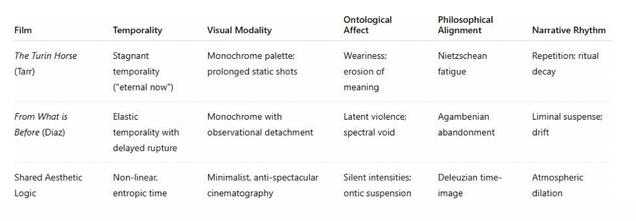
Figure 5, Chart by Çisemnaz Çil. This comparative table synthesizes key aesthetic and philosophical dimensions across Béla Tarr’s The Turin Horse (2011) and Lav Diaz’s From What Is Before (2014). Categories such as temporality, ontological affect, and narrative rhythm are not exhaustive but serve to foreground the shared logics of atmospheric disintegration and epistemic refusal in both films. Whereas Hardt and Negri would envision a technologically-mediated community that is capable of negating spatial distances, both films close down any possibility of such a vision. There are no screens, phones, or digital mediators in sight. The sole “signal” in The Turin Horse is the wind—a force that generates estrangement rather than proximity. In From What is Before, transmissibility assumes the mode of rumor and cries—acoustic soundscapes symptomatically articulating disintegration. In doing so, the globalized togetherness envisioned by the theorists is rendered anachronistic, if not utopian. Tarr and Diaz negotiate the vulnerability of such assumptions to material, historical, and political realities.
What if merely not arriving, abstaining from presence, thumbing its nose at closure, coherence, and interpretive legibility, was actually an ethical position? What if the film image in its longest and most ghostly register resists comprehension, not through lack, but rather through excess—an excess of history, suffering, Blackness, time? This essay has unraveled rather than argued, shivered rather than concluded, and gotten itself caught in traces of forms that cannot be held. Describing the temporal, atmospheric, and ontological affinities between The Turin Horse and From What Is Before, we enter a space where film turns its nature into a poethical tool—a sensorium for all that should not be named. In order to retain that which recedes from knowledge—may well, be an ethical step into breakdown-exhaustion, and cycle of history. Our last testimony mode, may illegibility itself stretch out to witness.
[1] Lisa Samuels and Jerome McGann, “Deformance and Interpretation,” New Literary History 30, no. 1 (Winter 1999): 25–56.
[2] Gilles Deleuze, Cinema 2: The Time-Image (The Athlone Press, 1989).
[3] Giorgio Agamben, The Coming Community (Minneapolis: University of Minnesota Press, 1993).
[4] Paolo Stellino, “Nietzschean Themes in Béla Tarr’s ‘The Turin Horse’,” ‘Film-Philosophy’ 28, no. 2 (2024): 226–47.
[5] Friedrich Nietzsche, The Gay Science, trans. W. Kauffmann (Vintage: 1882/1974).
[6] Çağrı Duranay, Temporal Suspensions and Poetic Stagings of Subjectivity in the Cinema of Lav Diaz. MA thesis (Kadir Has University, 2022).
[7] Stellino, “Nietschean Themes in Béla Tarr’s The Turin Horse,” 246-47.
[8] Stellino, “Nietzschean Themes in Béla Tarr’s The Turin Horse,” 226–47.
[9] Stellino, “Nietzschean Themes in Béla Tarr’s The Turin Horse,” 238-242.
[10] Deleuze, Cinema 2, 230.
[11] Yüzüncüyıl and Buluş, “Hareket-İmge ve Zaman-İmge,”478.
[12] Yüzüncüyıl and Buluş, “Hareket-İmge ve Zaman-İmge,” 478.
[13] Denise Ferreira da Silva and Valentina Desideri. “Another Image of Existence: Denise Ferreira da Silva and Valentina Desideri on Their Practice of Poethical Readings, the COVID-19 Pandemic, and the Need for a Radical Reevaluation of Modern Politics,” interview by Eve Katsouraki and Georg Döcker, Performance Philosophy Journal. n.d. https://www.performancephilosophy.org/journal/article/view/388.
[14] Ferreira da Silva and Desideri, “Another Image of Existence,” 137.
[15] Christina Sharpe, In the Wake: On Blackness and Being (Duke University Press, 2016).
[16] Ferreira da Silva and Desideri, “Another Image of Existence.”
[17] Ferreira da Silva and Desideri, “Another Image of Existence,”148.
[18] Yüzüncüyıl and Buluş, “Hareket-İmge ve Zaman-İmge,” 467–482.
[19] Yüzüncüyıl and Buluş, “Hareket-İmge ve Zaman-İmge,” 467–482.
[20] Yüzüncüyıl and Buluş, “Hareket-İmge ve Zaman-İmge,” 467–482.
[21] Chris Marker, Letter from a Marker. Video essay. YouTube.7.34. MUBI, November, 29, 2021. https://www.youtube.com/watch?v=-RONF1x4vCg&t=18s .
[22] Marker, Letter from a Marker.
[23]Ferreira da Silva and Desideri, “Another Image of Existence.”
[24] Marker, Letter from a Marker.
[25] Sharpe, In the Wake.
[26]Yüzüncüyıl and Buluş, “Hareket-İmge ve Zaman-İmge,” 467–482
[27]Ferreira da Silva and Desideri, “Another Image of Existence.”
[28]Ferreira da Silva and Desideri, “Another Image of Existence.”
[29] Lauren Berlant, Cruel Optimism (Duke University Press, 2011).
[30] Agamben, The Coming Community, 1993.
[31] Judith Jack Halberstam.The Queer Art of Failure (Duke University Press, 2011).
[32] Marker, Letter from a Marker.
[33] Karen Barad, Meeting the universe halfway: Quantum physics and the entanglement of matter and meaning (Duke University Press, 2007).
[34] Barad, Meeting the universe halfway.
[35] Sharpe, In the Wake.
[36] bell hooks, Black Looks: Race and Representation. (South End Press, 1992).
[37] Frantz Fanon, The Wretched of the Earth (Grove Press, 1963)
[38] Silva and Desideri, “Another Image of Existence,” 10.
[39] Sharpe, In the Wake.
[40] Ferreira da Silva and Desideri, “Another Image of Existence.”
[41] Ferreira da silva and Desideri, “Another Image of Existence.”
[42] Sharpe, In the Wake, 22.
[43] Berlant, Cruel Optimism, 23–50.
[44] Yuk Hui, “On the Persistence of the Non-Modern,” Afterall 51 (Spring/Summer 2021): 60–73, https://doi.org/10.1086/717401](https://doi.org/10.1086/717401.
[45] Michael Hardt and Antonio Negri, Multitude: War and Democracy in the Age of Empire Penguin Press, 2004).
[46] Barad, Meeting the universe halfway.
[47] Barad, Meeting the universe halfway.
[48] Sharpe, In the Wake, 22.
[49] hooks, Black Looks.
[50] Carina Buckley, Fluid Ethics: Community and Transformation in the Digital Age (Routledge, 2017.)
[51] Hardt and Negri, Multitude.
[52] Samuels and McGann, “Deformance and Interpretation.”
[53] Samuels and McGann, “Deformance and Interpretation.”
[54] Samuels and McGann, “Deformance and Interpretation.”
[55] Judith Butler, Gender Trouble: Feminism and the Subversion of Identity (Routledge, 1990).
[56] Saidiya Hartman, Lose your mother: A journey along the Atlantic slave route (Farrar, Straus and Giroux, 2007).
[57] Samuels and McGann, “Deformance and Interpretation.”
[59] Yüzüncüyıl and Buluş, “Hareket-İmge ve Zaman-İmge,” 467.
[60] Ferreira da Silva and Desideri, “Another Image of Existence.”