Adam Kane
Adam Kane is a cartoonist, teacher, and PhD candidate in English at Boston University. His dissertation in-progress, “Browknitting Whimsy: Comics Nonsense from Rodolphe Töpffer to Lynda Barry,” explores the aesthetic and historical relationships between comics and literary nonsense. His own comic strips regularly appear on SOLRAD Presents and in the local comics shops of Boston. He also occasionally leads workshops on cartooning.
About the Zote What Can Be Said? Edward Gorey, Nonsense, and Comics
In 2019, the Edward Gorey House held an exhibition called Hippity Wippity: Edward Gorey and the Language of Nonsense, curating examples of the late author’s relationship to the genre of literary nonsense. The exhibit docent script reads, “Hippity Wippity is about the fluid nature of image and story—the realization that everything is open to innumerable interpretations, and Gorey, in his work, requires you to do so.”[1] The title of the exhibit comes from Gorey’s picture story, [The Untitled Book] (1971), which features exclusively made-up words for its text, and an ambiguous pictorial sequence of fantastical creatures. Literary nonsense, resonating with the ever-ambiguous Gorey, is a tradition so niche that most people do not know about it, and those who study it do not completely agree on what it is. Broadly speaking, literary nonsense is a narrative and poetic genre that emphasizes the play with language, aesthetic form, or any system for meaning-making, such as logic. Wim Tigges argues in An Anatomy of Literary Nonsense (1988) that the essential element of nonsense is the question of meaning: “[Nonsense is] a genre of narrative literature which balances a multiplicity of meaning with a simultaneous absence of meaning.”[2] Popularized by the Victorian writers Lewis Carroll and Edward Lear, the nonsense genre prompts us to engage deeply with a text that appears to mean nothing at all. To label something nonsense (in a literary context) suggests an unresolvable tension in its significance and insignificance. As Gorey’s oeuvre (which Tigges calls “pure samples” of nonsense[3]) demonstrates, this genre can manifest in a wide range of literary forms. Each of Gorey’s books offers a new kind of formal play that throws you off in its own special way. Gorey takes the components of the picture story form, and tests how we construct narratives from them; how words and images ‘speak’ to and against each other in different ways. As I will explore, Gorey’s particular brand of nonsense does not merely play with the meaning we derive from language, but comics language—the complex interplay of words and visuals in succession, and the gaps between them that we fill in to assemble the story. This play with significance, for Gorey, is an existential disruption, a humorous reminder of life’s inexplicability and the failure to represent it verbally, visually, or verbo-visually.
Because nonsense refuses us the safety of meaning, our expectations for a genre, plot, or character are all eligible for disruption. Gorey’s small, unassuming volumes present themselves as children’s picture books, but their contents douse any expectations for the rosy warmth we associate with the genre. Their dimensions are always small but varied, and contain austere wintery landscapes, highly stylized stone-faced figures, and elusive and unsentimental stories. They don’t seem to be for children or adults; booksellers have been unsure of where to shelve them.[4] Even the physical character of some of Gorey’s books test our willingness to label them books: Les Échanges malandreux (1985) has two spines with interchangeable characters and captions; The Helpless Doorknob: A Shuffled Story (1989) is a deck of cards; The Nursery Frieze (1964) is (as described) a nursery frieze strip. His stories draw from genres such as gothic literature, surrealism, mystery, theatre of the absurd, haiku, German folk tales, and the abecedarium—and never fully commit to any of them. The subtitle of The Curious Sofa (1961) ironically proclaims to be a “Pornographic Work,” detailing the behavior of a bunch of apparent libertines without a trace of nudity or even a direct description of sex or human anatomy. The Awdrey Gore Legacy (1972) is a direct homage to the mysteries of Gorey’s idol Agatha Christie, and yet only in fragments: it features character designs with accompanying traits and biographies, illustrations of settings for potential murder sites, and cards listing potential murder methods (e.g., the card labeled “INSTANTANEOUS” shows a boulder; the card labeled “INEXPLICABLE” shows confetti).[5] As in the metafiction of Jorge Luis Borges, Gorey only posits Christie books, and so there is no limit to the shapes they can take. It is as if, out of sheer reverence, Gorey wanted to write endless Christie novels—by not writing them. Gorey’s books are not quite novels and not quite picture books; not quite fine literature and not quite novelty; not quite sensical and not quite balderdash. Despite the consistency of Gorey’s drawing and writing style across his bibliography, his most reliable trait is this unease. “I think there should be a little bit of uneasiness in everything,” he says, “because I do think we’re all really in a sense living on the edge. So much of life is inexplicable.”[6]
Gorey’s particular brand of inexplicability appears incidental. It is unclear if his meandering book The Prune People (1983) is interested in conveying anything at all to anyone. The Prune People is a wordless series of tableaux of faceless, prune-headed figures engaging in various activities, and there is little more I can say to describe it. One page shows three prune-headed adults standing stiffly in the woods, ostensibly watching leaves fall; the next page shows a prune family in Sunday dress (or funeral attire) walking along a nondescript path.[7]
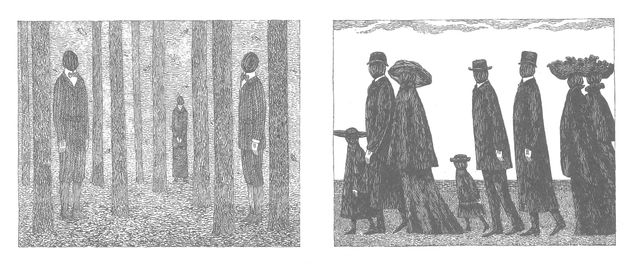
Most disquietingly, we have no text to ground our impressions. Gorey’s prunes are entirely average, faceless, and bored. The lack of occasion that underscores Gorey’s work gives one the paradoxical impression that his stories are self-evident and ordinary, existing independently of the burden to mean something, to be situated in a historical context, or to be labelled. Unlike the self-reflexivity of his experimental, postmodern contemporaries, Gorey’s books seem to simply exist without comment on themselves. Gorey himself expressed an interest in artwork that tongue-tied its readers: “Explaining something makes it go away, so to speak; what’s important is left after you have explained everything else. Ideally, if anything were any good, it would be indescribable.”[8] For him, the true essence of anything escapes language—but rather than only present wordless books, he plays with the pitfalls of text and image together. These two modes, when hybridized, multiply interpretations in ways mere prose could not. As I will explore, it is not through language but the fissures of language (verbal and visual) that his expression of the indescribable is achieved.
How can we talk about an indescribable expression? I fear explaining Gorey away, as is the academic habit. It would be a terrible mistake to read Gorey with the aim of pinning down the meaning of his work, rather than to see it as a site for play: to stage possible meanings, and to allow this family of possibilities to form a picture of his world. Gorey’s trademark elusiveness is not a hostile boarding up of windows to some private, esoteric significance. Rather, whatever shape the strangeness of a Gorey book takes is a signal to dissolve our habitual fixation on meaning, and to instead read playfully, without aim, for the sake of reading. One of the most important of Gorey’s statements on his own work encourages this: “And the way I write, since I do leave out most of the connections, and very little is pinned down, I feel that I’m doing a minimum of damage to other possibilities that might arise in the reader’s mind.”[9] In Gorey’s works, possibilities “arise”—they are not found or uncovered, and they must be protected as if living things. For Gorey, the signs that construct a story—the words and pictures—must somehow point to what cannot be contained by a story, that which is outside of the bounds of sense.
In another interview, Lisa Solod asks Gorey if there is anything people do not understand about him, and he responds, “Yes. No. Yes. No. I think I have to leave it up to them.”[10] Despite our avowed disinterest in labels, the Yes/No-ness of Gorey and his work, along with its invitation for reader participation, situates him neatly in the tradition of literary nonsense. The label of “nonsense” does not truly solve the problem of placing Edward Gorey—it merely helps us understand that the problem is its own solution. Gorey’s work is quintessentially nonsensical in that each of his books distinctly jeopardizes the act of signification in the name of play. As G.K. Chesterton, a noted nonsense advocate, writes in his essay, “Two Kinds of Paradox” (1911), “Nonsense ought to be suggestive … You can do something with the idea; it opens an avenue”[11] This, of course, directly echoes Gorey’s own sentiment about preserving possibilities for readers. For Gorey and Chesterton, provoking confusion is a generative act. This ‘suggestive nonsense’ must be executed with balance for the confusion to turn into wonder. As Gorey says, “Nonsense really demands precision.”[12] The reader must have a creeping sense, despite all apparent absurdity, that the book conceals something from them. In order to keep the game going, the rules must be arranged carefully so that there is never a winner, but the players will still want to play. As Gorey biographer Mark Dery puts it, “with Gorey, never getting there is half the fun.”[13]
Let us look at an example of Gorey multiplying possibility, by busting open the sequential nature of stories.
The Helpless Doorknob
As mentioned above, The Helpless Doorknob: A Shuffled Story is in one sense a picture book, but in another sense a deck of cards: the twenty “pages” have no spine; instead, they sit loose and unbound in a modest box, with the dimensions, thickness, and finish of trading cards. Yet, the box calls itself a “story,” and each card features one picture and one caption, depicting the faintest hint of a narrative: a character performing an action of some kind that begs for context or suggests further consequence. One card reads, “A mysterious urn appeared on the grounds,” featuring a corresponding image of a plump urn with unexplained, meteoric craters.[14] The subject is never explored on another card. In fact, no card seems to be more or less narratively connected to any other. Gorey only teases loose connections using recurring characters with maddeningly similar “A” names, and occasionally mirrored actions: “Albert left for Peru,” says one card; “Alfred returned from Nova Zembla” says another.[15] In the former, the image shows Albert exiting to the right of the frame, while the latter shows Alfred entering from the right. Had these cards been deliberately sequenced so one followed the other, the sense of symmetry and similarity would create a lightly humorous parallel. However, when read in sequence by accident, or even by the reader’s deliberate construction, the reader experiences a novel sense of serendipitous visual or narrative rhyme, as when the turn signals of two cars happen to synchronize. Nonsense toys with our desire for order, and so frequently employs different iterations of rhyme and resemblance that offer a mere formal relation and little more.[16] Unlike the rhyme scheme of a regular poem, a nonsense rhyme is arbitrary and comical; its connections offer no meaningful content. Gorey’s visual and conceptual rhyme here is a simulated accident.
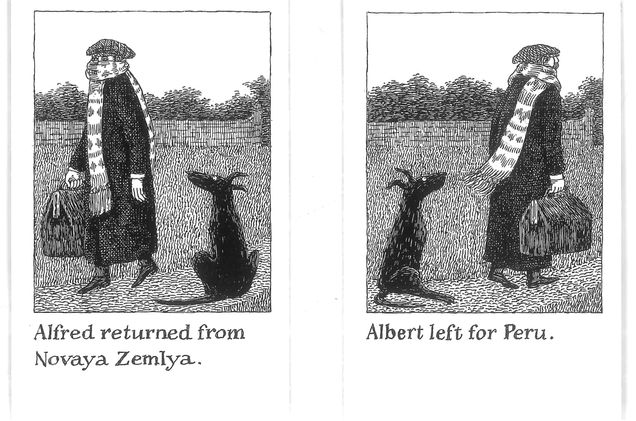
Consequentially, there are many combinations in The Helpless Doorknob wherein the reader is offered no such serendipity. One may continue the deck and read, “Angus inherited the grandfather clock from Aunt Ada” followed by “Adela could not find her way out of the woods.”[17] Without the guarantee of a satisfying coincidence, often the cumulative effect of this ‘book’ is not a sense of proliferating and alternating narratives—where the shuffling of the cards creates new but equally cohesive stories. Rather, like the eponymous doorknob, we are helpless as we open up new possibilities and thereby more red herrings. We see that Chesterton’s optimistic rendering of nonsense as ‘opening up avenues’ becomes daunting for the Gorey reader. Each card feels like the start of its own story—putting them together does not often yield satisfying results. Rather than generate cohesive mystery stories, Gorey merely multiplies mysteries. Gorey’s flirtation with the mystery genre here reveals nonsense to be a kind of unsolvable mystery. The many conceptual questions we can entertain about time, cause and effect, and form seem more satisfying to wander through, than the possible plots that could ‘tie everything together.’
The different ways we could play with The Helpless Doorknob is the true site of its interest. The reader’s level of autonomy is vast, because these cards do not instruct you on how to treat them. And to consider all of the ways we can treat them, we quickly see that their different permutations of time and cause-and-effect are equally vast. Since we have the freedom to lay these cards out on a table, in any order, we are free to suggest that these events all happen all at once. If true, we become omniscient readers as we watch time play out from multiple points in space. The narrative eye of The Helpless Doorknob could be like that of a security officer’s surveillance room, with multiple screens playing out simultaneously.
However, Gorey complicates this sense of simultaneity by reusing character names (but nevertheless changing their costumes) in certain cards, suggesting, for example, that the very same Adela lost in the woods also “flung Angela’s baby from an upstairs window”[18] in another card—and now she’s wearing new clothes. Is it really the same person? If so, how much later or earlier is this? If we assume a linear sense of time, how did she get out of the woods? We can choose to eliminate contradictory cards if we want, or to see these as two different Adelas, or to embrace the logical impossibility that Adele is both in the woods and tossing a baby from a window at once. The subtitle of this ‘book,’ A Shuffled Story, suggests (but only suggests) a beginning and end, a nod to cause and effect that is at best ironic. The Helpless Doorknob can both happen all at once and in sequence; it is both a story and is not; Adela is in two places at once, and is not. We are aware of alternative ways of treating this ‘book,’ but our awareness of its contradictions prevents us from making a definitive choice. The Helpless Doorknob never wants to be solved; it is an artifact of pure potential—endlessly generative and endlessly frustrating. Gorey has set up the book so you can never draw a sensical narrative for yourself.
Of course, not all of Gorey’s books take the shape of interactive novelties, but they offer a more material version of the play with reader participation and ambiguity that is essential to nonsense, as they multiply narrative shapes and diminish authorial control. As Mark Dery writes, “[Gorey’s] late-life flirtations with interactivity are also manifestations of his commitment, going back decades, to the aesthetic of open-endedness.”[19] The multitudinous, participatory nature of Gorey’s stories pollute the conditions for a safe sense of meaning-making; novelty renders each narrative a kind of changing organism. Gorey places the onus of significance on the reader, troubling (rather than fully destroying) the habitual sense that the phenomenon of narrative cause-and-effect is external—it is an illusion we take part in.
The Helpless Doorknob exhibits Gorey’s long-standing fascination with the picture story as a sequence of fragments. On this point, we must draw attention to the unusually visual-sequential nature of his work. Nonsense is a game of language and meaning, and definitions often emphasize the genre’s verbal format. Yet, Gorey is a visual artist as much as an author. He is often handled by critics either as a writer or an illustrator, and less often as a cartoonist—the hybrid species of both roles. In fact, Gorey’s nonsense is best read as the sequential play of image and text—that is, as comics. While enough critics discuss Gorey’s aesthetic of leaving things out, they do not often discuss the various ‘gaps’ Gorey achieves through the sequential, visual-verbal nature of comics—the gaps between pages, between images, between words and images. Paradoxically, in the many failures to categorize Gorey, we arrive at what I will call comics nonsense, the interplay of images and text in sequence to evoke an irrational, aesthetic wonder. Comics nonsense allows Gorey to stylistically depict the tension of language and the unnamable world that precedes it. In this form, Gorey may freely hop between so many disparate genres and mediums: he may visually evoke the collages of Max Ernst with the suggestive, spare language of Japanese novels. His work simultaneously evokes Samuel Beckett’s brutal sparse and indifferent language, and the elegant and melodramatic crosshatching of Victorian illustration; the sensational mystery novel may coexist with the simplistic illustration of children’s cautionary tales. The eclectic hybridity of Gorey’s work is not merely a question of genre-hopping, but a question of his play with word and image in sequence—that is, his unique contribution to the medium of comics.
It may initially seem dubious to label Edward Gorey as a comics artist, given that his books most often resemble children’s picture books. However, I am working under Scott McCloud’s definition in Understanding Comics that comics are “juxtaposed images in deliberate sequence,”[20] which would include what we often distinguish as children’s picture books.[21] In fact, McCloud himself places Gorey in a list of cartoonists we should consider comics artists.[22] While a glance of Gorey’s work shows greater influence from nonsense writers and children’s book illustrators than from the likes of newspaper or comic book cartoonists, Gorey was also an avowed fan and collector of George Herriman’s comics,[23] and he had a copy of Coulton Waugh’s The Comics on his desk when he died.[24] His four-panel comic strip, A Limerick, is the most overtly comics-like to the casual reader, with four square panels to be read as a single composition.[25]
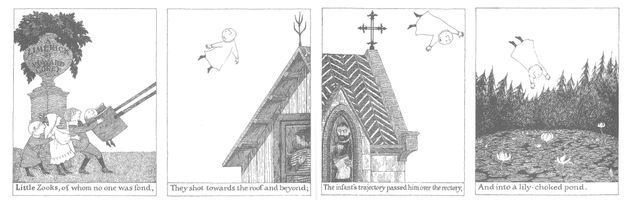
This is a unique example of Gorey’s sensitivity to tracing a path for the eyeline to arch across each panel. Nevertheless, it’s unlikely that Gorey thought of his own works as comics in the ordinary sense. Elsewhere it is clear that he most often prefers the picture book convention of one image and caption per page, but even this is blurred by the publication of his collected works in the Amphigorey series, wherein multiple pages of his books are collected on larger pages, and suddenly take on a more comics-like, “panel” appearance. Comics seldom come up in assessments of Gorey’s work. Just as well, while he is revered by many cartoonists, and his influence is clear (see Richard Sala), you will not find him in any anthologies of graphic fiction or in narratives of comics history. I will rest on McCloud’s definition and say that the lens we may put on to see Gorey’s work as comics allows us to consider the uniquely sequential, visual, and verbal nature of his brand of nonsense.
Notably, the posterchildren of nonsense include drawings in their work—Lear’s poems and stories are always accompanied by whimsical sketches of his own hand; Carroll’s Alice’s Adventures in Wonderland was initially illustrated by himself, but then turned over to John Tenniel for the published version. Nevertheless, when defining nonsense, theorists emphasize a play with language, with often little mention of images. Tigges writes, “To summarize, literary nonsense is characterized by four essential elements: an unresolved tension between presence and absence of meaning, lack of emotional involvement, playlike presentation, and an emphasis, stronger than in any other type of literature, upon its verbal nature.”[26] Indeed, Gorey is the only figure in Tigges’s study whose chapter includes an involved discussion of images, Lear somewhat excepted. Likewise, Susan Stewart’s extensive, anthropological survey of nonsense, Nonsense: Aspects of Intertextuality in Folklore and Literature (1979), makes no room for the discussion of images at all. It would seem that images are only supplementary to verbal nonsense, merely illustrating what the text implies.
However, Gorey is not without precedent in the interplay between images and text as a playground for nonsense. Several early newspaper cartoonists were influenced by Edward Lear and Lewis Carroll: Gustave Verbeek, Peter Newell, and Winsor McCay each published a form of comics nonsense that evoked their Victorian progenitors, while offering a more consequential interplay of words and images. For our purposes, I want to single out one comic that bears a remarkable resemblance to Gorey’s book The Utter Zoo (1967), called The Woozlebeasts (1904-1905).
The Utter Zoo and J.P. Benson’s The Woozlebeasts
Gorey’s The Utter Zoo features nonsensical couplets, describing the imaginary beasts that are illustrated above them. This book features some of his most minimalist sets and evocative lines (both visual and verbal), and some of his beasts even visualize the phonetic texture of their own names. The wide to thin sound that occurs when we pronounce “the Ampoo” is a synesthetic echo of the creature’s physique.[27]
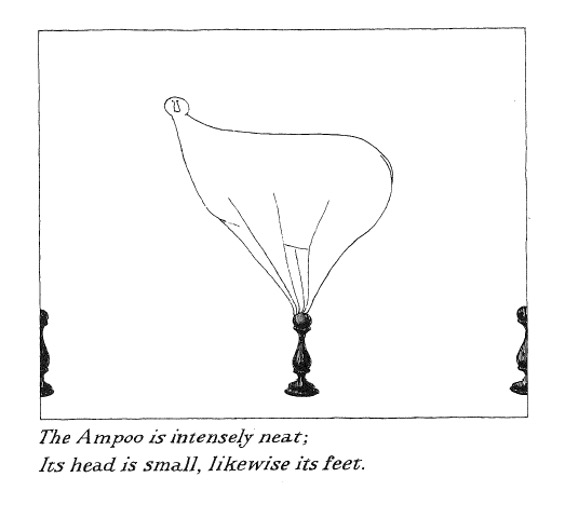
While this book is clearly influenced by his hero Edward Lear (some of whose works Gorey illustrated himself), Lear’s illustrated limericks often restricted themselves to an array of daffy Victorian humans. Gorey’s book actually bears much closer resemblance to John Prentiss Benson’s newspaper comic The Woozlebeasts, a turn-of-the-century strip that, in a run that lasted less than a year, illustrated over one hundred nonsense creatures with accompanying poems.
The Woozlebeasts was part of a “minor tradition of fantastic animals” in the papers, including Gustave Verbeek’s Little Lulu, The Terrors of the Tiny Tads, and Hellen Stilwell’s illustrated rhymes.[28] Benson’s work is undeniably whimsical, and reminiscent not only of Carroll’s pension for evocative creatures, but also Edward Lear’s use of limericks as portraiture. Benson writes: “The Tham always lisps when he speaks, / And is bashful and saucy in streaks / His chief joy in life is to aggravate strife; / He is one of our commonest freaks.”[29] Like Lear and Carroll, Benson provides an absurdly specific portrait of his beast, characterizing it with human fickleness, and a touch of vague detail: What does the Tham do to cause strife? It’s nowhere to be seen in the image, but the charged word “saucy” and the mischievous look in its eye suggest more than the poem offers in explanation.
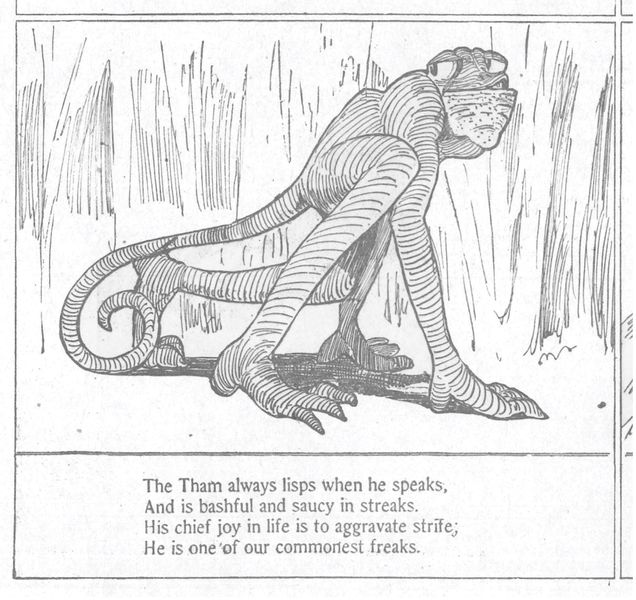
Detail of a 6-panel Woozlebeasts strip, featuring the saucy Tham. J.P. Benson, The Woozlebeasts in Lil’ Sammy Sneeze: The Complete Color Sunday Comics 1904-1905 (Palo Alto, California: Sunday Press Books, 2007), 18 September 1904.
The suggestiveness of nonsense takes full force in Gorey’s Utter Zoo, however. In only two economic lines, he gleefully throws us off: “The Kwongdzu has enormous claws / Its character is full of flaws.”[30] The image, however, only shows a starling-esque bird with big claws and no discernable inadequacy. While Benson gives his demur Tham an expressive side-eye look, Gorey omits any suggestion from his illustration that the Kwongdzu has any character at all.
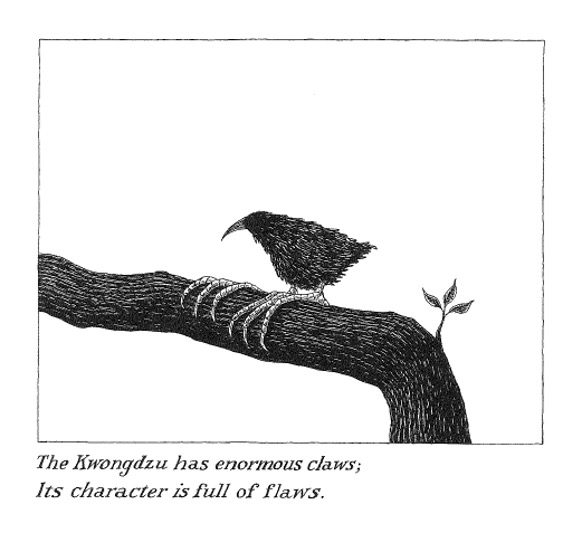
The couplet and the illustration are merged in the first line, supporting one another in meaning because we can read and see the Kwongdzu’s claws—but they depart in the second line. The poem somehow says more than the picture discloses, but not enough! (Of course, in the sense that this omission is the crux of the poem’s humor, it is enough.)
It’s not clear if Gorey knew of The Woozlebeasts, but the similarity in spirit is incredibly striking: not only is the format nearly the same (nonsense creatures with onomatopoetic names and accompanying rhymes), but both artists revel in a nonsensical specificity, and alternate vagueness. However, Benson’s Woozlebeasts want you to know them, with memorable quirks and characteristics: “If successful in hunting the Bemba / It’s a thing you are sure to remember / They flutter in droves through the palmetto groves / From the first to the tenth of September.”[31] Benson even directly asks you to remember the beasts as the short-lived strip ends on New Year’s Day: “This parting’s not as jolly as it seems; / While admitting it’s a pity that so few of us are pretty, / Yet we ask to be remembered in your dreams.”[32]

Benson begs for sympathy and some lasting influence as he terminates his unappreciated comic. The accompanying drawing is dramatically lit by a wood fire as the beasts (ever woozy in appearance) gather around it. Our unseemly friends must keep warm as they are cast away, forever misunderstood. Meanwhile, The Utter Zoo ends in characteristic Gorey fashion: “Of the Zote, what can be said? / There was just one, and now it’s dead.”[33] We are not even allowed to see it—only little paws peek from the lip of the box. Ever the suggestive illustrator, Gorey shows us by the curtains and candles that the Zote had a domestic, ceremonious, and somewhat lavish funeral.
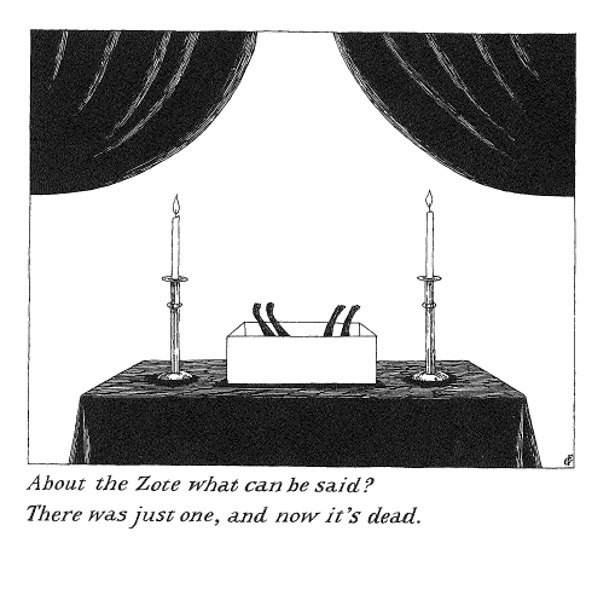
It’s clear from Gorey’s ending that he is indifferent to the lives of his creations—there is no preciousness to be found, no appeal to our emotions. Gorey deeply loved animals—especially cats—but he does not permit his work sentimentality. What Gorey omits supplies the significance to The Utter Zoo: the loss of the Zote is expressed by its anonymity to the reader. The only details of the couplet regard its rarity and extinction; the only visual representation we get is of its corpse. In fact, many of Gorey’s beasts hide: The Boggerslosh “conceals itself / In back of bottles on a shelf,” the Dawbis “is remote and shy,” the Jelbislip is “kept inside a jar,” and the Ulp “is very, very small; / It can hardly be seen at all.”[34] While The Woozlebeasts emphasized an attempt to make the fantastical disarmingly familiar, and to see impossible creatures as persons, Gorey’s Utter Zoo encourages us to turn to images when language is vague, and alternately turn to language when images conceal—until we realize that neither can help us know these creatures.
Alexander Theroux writes, “I am convinced that Gorey’s work has more to do with language than anything else – it’s dilemma, its inexactitude, its ambiguities, its enigmas, its comic possibilities.”[35] Gorey himself has said, “I have wondered if I wasn’t trying to do something different than most people with the English language.”[36] Many of Gorey’s critics emphasize his evocative treatment of language as a matter aside from his drawing, and in so doing emphasize Gorey’s status as a writer. However, Gorey’s play with the language involves the treatment of images as language. Because Gorey’s books take on the appearance of illustrated children’s books, wherein pictures merely “illustrate” the text, the rich and unique interplay between word and image and across pages is easy to overlook in his books. In most children’s books, the images more or less depict what the text points towards, even in works of nonsense like Alice’s Adventures in Wonderland. When Alice sees the White Rabbit take a watch out of his pocket, that is just what we see.[37] While certain visual details inevitably emerge from the exactitude of Tenniel’s illustrations, he obviously follows Carroll’s lead throughout the book. This is distinct from comics, wherein the images and text “are like partners in a dance and each one takes turns leading”[38] as McCloud says. In comics, visuals supply information that can be independent of any accompanying text, sometimes advancing the narrative more than any narration. This dance clearly fascinated Gorey.
Hendrik van Leeuwen is one of the few critics to discuss the image/word binary of nonsense in his essay, “The Liaison of Visual and Written Nonsense.” In his discussion of Gorey, he promisingly characterizes the relationship of his illustrations and texts as a “symbiosis”[39] but makes their dividing line too clean and consistent: “In Gorey’s work text and picture diverge technically. The word evokes laughter, the image a tear.”[40] Elsewhere, he champions the genre of nonsense as a whole to “[sabotage] this dialogue” between left and right brain, word and image.[41] Just as McCloud argues for the ways in which comics can make images readable like language, and words like graphics,[42] Van Leeuwen sees nonsense subverting these same boundaries. He writes, “The maker of nonsense enjoys playing with loose images, ordering them in an unexpected way and tracing paradoxical modes of construction. … He desires to avoid worn-out patterns and to skip mental grooves.”[43] Nonsense defamiliarizes us from the way we typically derive meaning from images, but also from their relationship to words or other images. To provide an example and explore the importance of the sequential image-word relationship for Gorey, we will look at a book that tests these boundaries to the extreme.
[The Untitled Book]
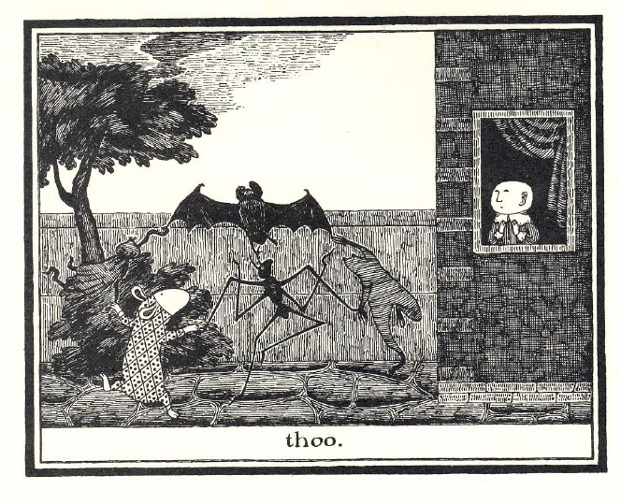
Named as one of Gorey’s favorite works by his own hand, because it “made the least obvious sense,”[44] [The Untitled Book] is giddily incoherent from multiple angles: it is comprised of vague imagery (unknown creatures dancing an unknown ceremony) and unhelpful captions of Latinate nonsense words such as “Ipsifendus” and Mother Goose rhymes, such as “Hippity wippity.”[45] Like many nursery rhymes, [The Untitled Book] favors sound over sense, and it gives a snorting wink to Mother Goose with Gorey’s own barnyard nom de plume, “Edward Pig.” Of course, Gorey’s nursery rhyme is not quite a nursery rhyme. Across its sixteen pages, we see a set of fantasy creatures dance in front of a bald Edwardian child on an overcast day, only for some kind of flaming black mass to send the creatures tumbling back to their hiding places. The story ends there, with the child looking back at the reader as if to ask, “What was that about?” while the caption below sighs, “hoo.”[46] Though the dance of the nonsense creatures and the sing-song language certainly resemble a nursery rhyme, this book is clearly more distinctive than a mere parody or homage: its lack of occasion expresses something about the function of language, image, and (as with The Helpless Doorknob) the brief moments of synchronicity that occur in a life governed by unreason.
Each page shows one image with one line of the poem, paced evenly so as to advance the story one step at a time. Gorey maintains the same compositional framework in each image as well. The original 1971 edition was published with only one page printed per sheet, isolating each step in the poem and image as a unit, creating a steady verbal-visual rhythm. As such, we notice the subtle changes in the child’s head turns and minute hand gestures across pages, as well as the rustling of the tree leaves and the meditative shapeshifting of the clouds. These action-to-action transitions (as McCloud would call them)[47] also create a sense of authorial disinterest, as the story’s visuals never waiver from their fixed place.[48]
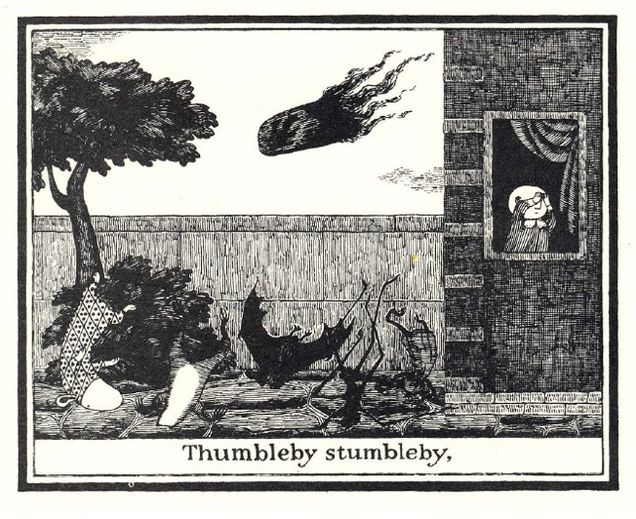
Dery quotes Lanes’s reading of [The Untitled Book] as an “attempt at divining some rudimentary pattern from the world’s unreason”[58] and he responds, “If so, the moral of Gorey’s story is that all such attempts are doomed to failure.”[59] While I agree that the story presents such a challenge to the reader through its play with language, as any of his most nonsensical works—I also detect in its unreason an undercurrent of joy. Despite his deeper comments, Dery calls the book “a little ditty,”[60] and Lanes calls it “a perfectly rounded little dance-drama.”[61] Dery’s stronger emphasis on “a loss of faith,” “failure,” and “doom,” fails to draw out the significance of the comic’s “ditty”-ness: the subtle importance of its unassuming sing-song quality. Alan Watts, in his lecture on the “Sense of Nonsense,” says, “Well, ‘alleluia’ may have meant something originally, but as it is used now it does not mean anything, except perhaps ‘whoopee!’ It is an exclamation of nonsensical delight. . . .”[62] Can we not say the same of Gorey’s giddy “Hippity wippity” and the unaccountable dance number? Watts writes, “the scheme of things seems to justify itself at every moment of its unfoldment. I pointed out that this was particularly characteristic of music, of dancing. . . .”[63] In Gorey’s comic, for all its apparent inconsequentiality, we see a love of rhythm and dance, as merged by sound (or, rather, sound-poetry) and image, gathering itself up out of nowhere—the delicacy and rarity of an utterly pointless, celebratory moment converges before it is chased away. Gorey’s characteristic hopeless confusion is present, but it gives rise to an ephemeral joy. The humor is somehow both alienating and delightful, its vagueness simulates a holistic view of the liberating glee and indifference of an unreasonable world. Perhaps this is what Lanes senses when she writes of [The Untitled Book], “its alien reality notwithstanding, it is curiously satisfying.”[64]
Gorey’s comics tease an aesthetic response that is designed to fail. This is where Gorey’s work hits the exact intersection of the stylistic potential of both comics and nonsense: the play with the act of reading images in sequence becomes our failed attempts to fix significance on an unnamable, ever-changing reality. Dery explains how Gorey’s philosophy is embedded in his aesthetic choices:
Gorey believed that the deepest, most mysterious things in life are ineffable, too slippery for the crude snares of word or image. To manage the Zen-like trick of expressing the inexpressible, he suggests, we must use poetry or, better yet, silence (and its visual equivalent, empty space) to step outside language or allude to a world beyond it.[65]
He rightly points out that images are as much of a “snare” as words for Gorey—mere signs, red herrings and masks of what is really going on—and that his omissions of visual and verbal detail are where an expression of universal emptiness resides. (Does Gorey express this, or provide a space to let this emptiness express itself?) To add to Dery’s point, for Gorey it is not mere poetry that achieves this indirect expression, it is nonsense poetry; it is not mere imagery, but nonsensical imagery—writing and drawing that exists for its own sake; it may mean something, but it also may have nothing to say beyond its own half-familiar, half-strange sound and texture.
Chesterton writes in another essay, “A Defence of Nonsense,” that different genres of literature must be “allegorical for some view of the whole universe”, and so “the world must not only be tragic, romantic, and religious, it must be nonsensical also.”[66] For him, the features that define a genre also emphasize a set of aspects of the human experience; therefore, literary nonsense estranges us from the orderliness of commonsense: Its upside-downwards approach to our systems of organization and reason offers a tidy metaphor for the ineffable mysteriousness of ordinary life—a mysteriousness that is doused by the over-reliance on everyday language and logic. Chesterton writes summarily that “a thing cannot be completely wonderful so long as it remains sensible.”[67] The inability to completely explain something—that insurmountable margin of ambiguity—is itself the subject of literary nonsense, and of Gorey’s work. Nonsense both hops the modal boundaries of image and language and offers us glimpses of an existence that precludes signs and symbols altogether. The reader comes away, not with an understanding of the text’s meaning, but joy through its absence.

[1] Gregory Hischak, “Hippity Wippity: Edward Gorey and the Language of Nonsense 2019 Exhibit Docent Script” (2019), 2. Provided to the author and used with permission from museum curator and script writer Gregory Hischak.
[2] Wim Tigges, An Anatomy of Literary Nonsense (The Netherlands: Rodopi, 1988), 47.
[3] Tigges, 192.
[4] Mark Dery, Born to Be Posthumous: The Eccentric Life and Mysterious Genius of Edward Gorey (United States: Little, Brown, 2018), 148.
[5] Edward Gorey, The Awdrey Gore Legacy in Amphigorey Also (New York: Barnes & Noble Books, 2002). No page numbers.
[6] Edward Gorey and Stephen Schiff, “Edward Gorey and the Tao of Nonsense” in Ascending Peculiarity: Edward Gorey on Edward Gorey, ed. Karen Wilkin (San Diego: Harcourt Press, 2002), 156.
[7] Edward Gorey, The Prune People in Amphigorey Also (New York: Barnes & Noble Books, 2002). No page numbers.
[8] Edward Gorey and Richard Dyer, “An American Original” in Ascending Peculiarity: Edward Gorey on Edward Gorey, ed. Karen Wilkin (San Diego: Harcourt Press, 2002), 123.
[9] Gorey and Schiff, “Edward Gorey and the Tao of Nonsense,” 154.
[10] Edward Gorey and Lisa Solod, “The Poison Penman” in Ascending Peculiarity: Edward Gorey on Edward Gorey, ed. Karen Wilkin (San Diego: Harcourt Press, 2002), 109.
[11] G.K. Chesterton, “Two Kinds of Paradox” in The Collected Works of G. K. Chesterton XXIX: The Illustrated London News 1911 – 1913, ed. Lawrence J. Clipper (San Francisco: Ignatius Press, 1988), 51-54, https://nonsenselit.com/g-k-chesterton-two-kinds-of-paradox-1911/
[12] Gorey and Schiff, “Edward Gorey and the Tao of Nonsense,” 147.
[13] Dery, Born to Be Posthumous, 19.
[14] Edward Gorey, The Helpless Doorknob: A Shuffled Story (Portland, Oregon: Pomegranate Press, 2015). No page numbers.
[15] Ibid.
[16] See Edward Lear’s “Nonsense Botany,” which features plants resembling disparate things such as parrots, faces, and instruments.
[17] Ibid.
[18] Ibid.
[19] Dery, Born to Be Posthumous, 385.
[20] Scott McCloud, Understanding Comics: The Invisible Art (New York: Harper Perennial, 2010), 9.
[21] This is analogous to the categorization of hotdogs as sandwiches or tomatoes as fruit: while the categorization seems counterintuitive to our ordinary perceptions, it is valid.
[22] McCloud, Understanding Comics, 18.
[23] Edward Gorey and Steven Heller, “Edward Gorey’s Cover Story,” in Ascending Peculiarity: Edward Gorey on Edward Gorey, ed. Karen Wilkin (San Diego: Harcourt Press, 2002), 238.
[24] As can been seen in a photograph in the book by Kevin McDermott, Elephant House or, The Home of Edward Gorey (Portland, Oregon: Pomegranate Press, 2003). No page numbers.
[25] Edward Gorey, “A Limerick,” in Amphigorey Too (New York: Perigree, Penguin Group, 1980). No page numbers.
[26] Tigges, An Anatomy of Literary Nonsense, 55. Emphasis mine.
[27] Edward Gorey, The Utter Zoo in Amphigorey Also (New York: Barnes & Noble Books, 2002). No page numbers.
[28] Dan Nadel, “The Woozlebeasts: Featured Creatures” in Lil’ Sammy Sneeze: The Complete Color Sunday Comics 1904-1905 (Palo Alto, California: Sunday Press Books, 2007). No page numbers.
[29] J.P. Benson, The Woozlebeasts in Lil’ Sammy Sneeze: The Complete Color Sunday Comics 1904-1905 (Palo Alto, California: Sunday Press Books, 2007), 18 September 1904.
[30] Gorey, The Utter Zoo.
[31] Benson, Woozlebeasts, 9 October 1904.
[32] Benson, Woozlebeasts, 1 January 1905.
[33] Gorey, The Utter Zoo.
[34] Ibid.
[35] Alexander Theroux, The Strange Case of Edward Gorey (Seattle: Fantagraphics Books, Inc., 2000), 17.
[36] Edward Gorey and Peter F. Neumeyer, Floating Worlds: The Letters of Edward Gorey & Peter F. Neumeyer (Portland, Oregon: Pomegranate Press, 2011), 125.
[37] Lewis Carroll, Alice’s Adventures in Wonderland in The Annotated Alice, ed. Martin Gardner and Mark Burstein (New York: W.W. Norton & Company, 1960), 12.
[38] McCloud, Understanding Comics, 156.
[39] Henrik van Leeuwen, “The Liaison of Visual and Written Nonsense” in Explorations in the Field of Nonsense, ed. Wim Tigges (The Netherlands: Rodopi, 1987), 62.
[40] Van Leeuwen, 80.
[41] Van Leeuwen, 92.
[42] McCloud, Understanding Comics, 148-149.
[43] Van Leeuwen, 83.
[44] Edward Gorey and Robert Dahlin, “Conversations with Writers: Edward Gorey” in Ascending Peculiarity: Edward Gorey on Edward Gorey, ed. Karen Wilkin (San Diego: Harcourt Press, 2002), 44.
[45] Edward Gorey, [The Untitled Book] in Amphigorey Too (New York: Perigree, Penguin Group, 1980). No page numbers.
[46] Ibid.
[47] McCloud, Understanding Comics, 70.
[48] One wonders if Gorey was at all inspired by Maurice Sendak’s book, Higglety Pigglety Pop! Or, There Must Be More to Life (1967). Sendak’s book depicts the whimsical and dissonant journey of a Sealyham terrier diva (meant to be a fictional version of Sendak’s own beloved pet Jenny). For our subject, its ending is most notable: a line-by-line, and action-to-action sequence of images that play out the Mother Goose nursery rhyme, “Higglety Pigglety Pop,” where the composition remains fixed on a single stage just like Gorey’s book.
[49] Tigges, An Anatomy of Literary Nonsense, 190.
[50] Dery, Born to Be Posthumous, 289.
[51] Elizabeth Sewell, The Field of Nonsense (Dublin: Dalkey Archive Press, 2015), 121.
[52] Sewell, Field of Nonsense, 118.
[53] Lewis Carroll, Through the Looking-glass in The Annotated Alice, ed. Martin Gardner and Mark Burstein (New York: W.W. Norton & Company, 1960), 174-175.
[54] Gorey, [The Untitled Book].
[55] Selma G. Lanes, “Edward Gorey’s Tantalizing Turns of the Screw,” in Through the Looking Glass: Further Adventures & Misadventures in the Realm of Children’s Literature (Boston: David R. Godine, 2004), 111.
[56] Dery, Born to Be Posthumous, 288.
[57] Tigges, An Anatomy of Literary Nonsense, 190.
[58] Lanes, “Edward Gorey’s Tantalizing Turns of the Screw,” 110, quoted in Mark Dery, Born to Be Posthumous, 289.
[59] Dery, Born to Be Posthumous, 289.
[60] Ibid. Here, Dery mistakenly claims that Gorey “eschews rhyme, his usual strategy for imposing order on nonsense.” However, “thoo” and “hoo” close off the two identically-structured stanzas that comprise the story, and many lines contain internal rhyme such as “Thumbledy stumbledy.”
[61] Lanes, “Edward Gorey’s Tantalizing Turns of the Screw,” 111.
[62] Alan Watts, “Sense of Nonsense” in The Tao of Philosophy: The Edited Transcripts (Tokyo: Tuttle Publishing, 1995), 69.
[63] Watts, “Sense of Nonsense,” 67.
[64] Lanes, “Edward Gorey’s Tantalizing Turns of the Screw,” 111.
[65] Dery, Born to Be Posthumous, 13.
[66] G.K. Chesterton, “A Defence of Nonsense,” in A Defence of Nonsense, and Other Essays (New York: Dodd, Mead & Co., 1911), 8-9, https://archive.org/details/defenceofnonsens00chesrich.
[67] Chesterton, “A Defence of Nonsense,” 9-10.