Advanced Studies Institutes: Coastal Zone Hazards
The Advanced Studies Institutes (ASI) program for U.S. graduate students was supported by National Science Foundation (NSF) and provided students with the opportunity to engage with global experts in coastal zone hazard research.
Each year a cohort of 10 -12 U.S. graduate students participated in a two-week summer program. Each year was held in one of the three participating research centers abroad:
- France in 2023 – University of South Brittany
- Japan in 2024 – Tohoku University
- Indonesia in 2025 – University of Diponegoro
The program was jointly run with foreign site collaborators and U.S. collaborators at Boston University, Northern Arizona University, and University of Alaska Fairbanks. Graduated students were selected to participate in pre-travel virtual orientation, on site orientation, two weeks of hands-on classroom, laboratory, and field training, and cultural enrichment activities in the respective ASI sites. The training program culminated with post-program follow-up activities.
Benefits of the Program:
- Opportunity to engage in cutting edge coastal zone research at various field locations
- Interact with global experts in coastal marine geology, tectonic geomorphology, earthquakes, tusnamis, coastal hazards, remote sensing, geospatial science, big data analytics, computer sciences
- Professional development activities
- All foreign expenses covered
Learning Objectives of the Program:
The Advanced Studies Institutes will help to address the current shortage in transdisciplinary researchers equipped to deal with the problems facing coastal zones and other marine ecosystems.
Through participation in these ASIs, students gained:
- Understand the role of physical-social-ecological factors in coastal zone disaster management, preparedness, mitigation and conservation.
- Acquire modern scientific communication skills by writing a series of blogs and through readings and lectures.
- Obtain practical scientific skills and expand their scientific network through the implementation of independent projects.
- Develop an inter- and transdisciplinary understanding of coastal marine geosciences and disaster science through field-based training and lectures in a range of disciplines, including marine and structural geology, climate change, coastal hazards, computing and data sciences, decision support systems, survey sensor technology.
- Learn about SAR and Optical Remote Sensing, Deep Learning, AI and other advanced computing techniques applied to coastal zone research.
- Gain scientific presentation skills in a range of modalities by writing a report summarizing their research findings and presenting their project during a presentation at the end of each ASI during a student symposium.
Participant Eligibility Criteria:
- U.S. citizen or permanent resident
- Must have a valid U.S. passport or international passport (with permanent resident card) with an expiration date no earlier than 6 months after the date of the return flight
- Currently enrolled as MS or PhD student working in the field of marine sciences, geosciences, geohazards or geospatial information sciences
- Prior training in GIS or remote sensing is highly desired (but not mandatory)
- Adhering to all COVID protocols and requirements for foreign site and the U.S.
- Agree to participate in post-program follow-up research activities
- Students from diverse backgrounds are encouraged to apply
Applications were assessed on the following criteria:
- Career advancement: Will the course aid the student in advancing their graduate research and/or reaching their career goals?
- Strength of candidate: How successful has the candidate been in prior graduate coursework and other professional metrics?
- Impact to research activities: Does the student have the potential to contribute a unique and under-represented perspective on coastal zone science?
 This program was supported by the National Science
Foundation Award No. NSF-OISE 2154238: IRES Track II:
Multidisciplinary Coastal Zone Hazards Institutes –
France, Japan, Indonesia.
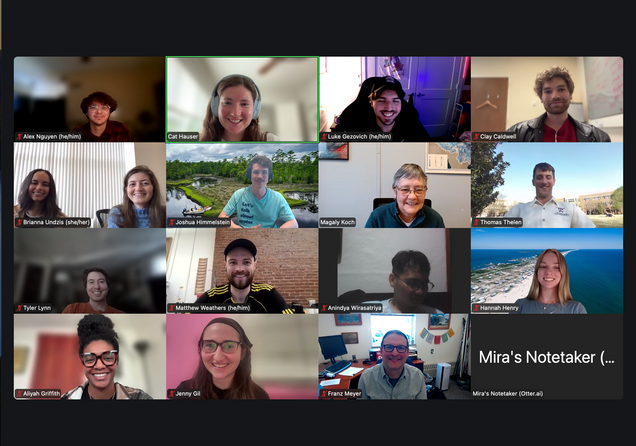
Reunion Meeting (March 23, 2026)