Until now, we have learned about cosmology primarily from the CMB (beginning of the universe) and from supernovae and galaxy surveys (late-time universe). To completely understand cosmological physics and the properties of the first stars and galaxies, we want to map the universe across its entire history. But there is a problem: using standard techniques, galaxies in the early universe are too faint to be detected in large quantities.
We are developing a new technique, called line intensity mapping (LIM), to efficiently measure large-scale structure in the early universe. There are two ingredients:
- Instead of resolving galaxies, use moderate-resolution observations to integrate over multiple emitters. While we don’t learn about individual objects, this method is more efficient at detecting cosmic structure in aggregate when the emitters are extremely faint.
- Identify an atomic or molecular line emitted by galaxies in the early universe. If we know the rest-frame wavelength, the observed wavelength provides the redshift, or distance away from us, and we can construct a 3D map of cosmic structure.
We focus on LIM at millimeter wavelengths, which is sensitive to far-infrared lines (in the galaxy rest frame) that are bright in distant galaxies, and which we can detect using instruments similar to those we build for the CMB. Our projections show that mm-wave LIM could provide an order of magnitude more cosmological constraining power than current galaxy surveys, testing the physics of dark energy, dark matter, neutrinos, and inflation to unprecedented precision.
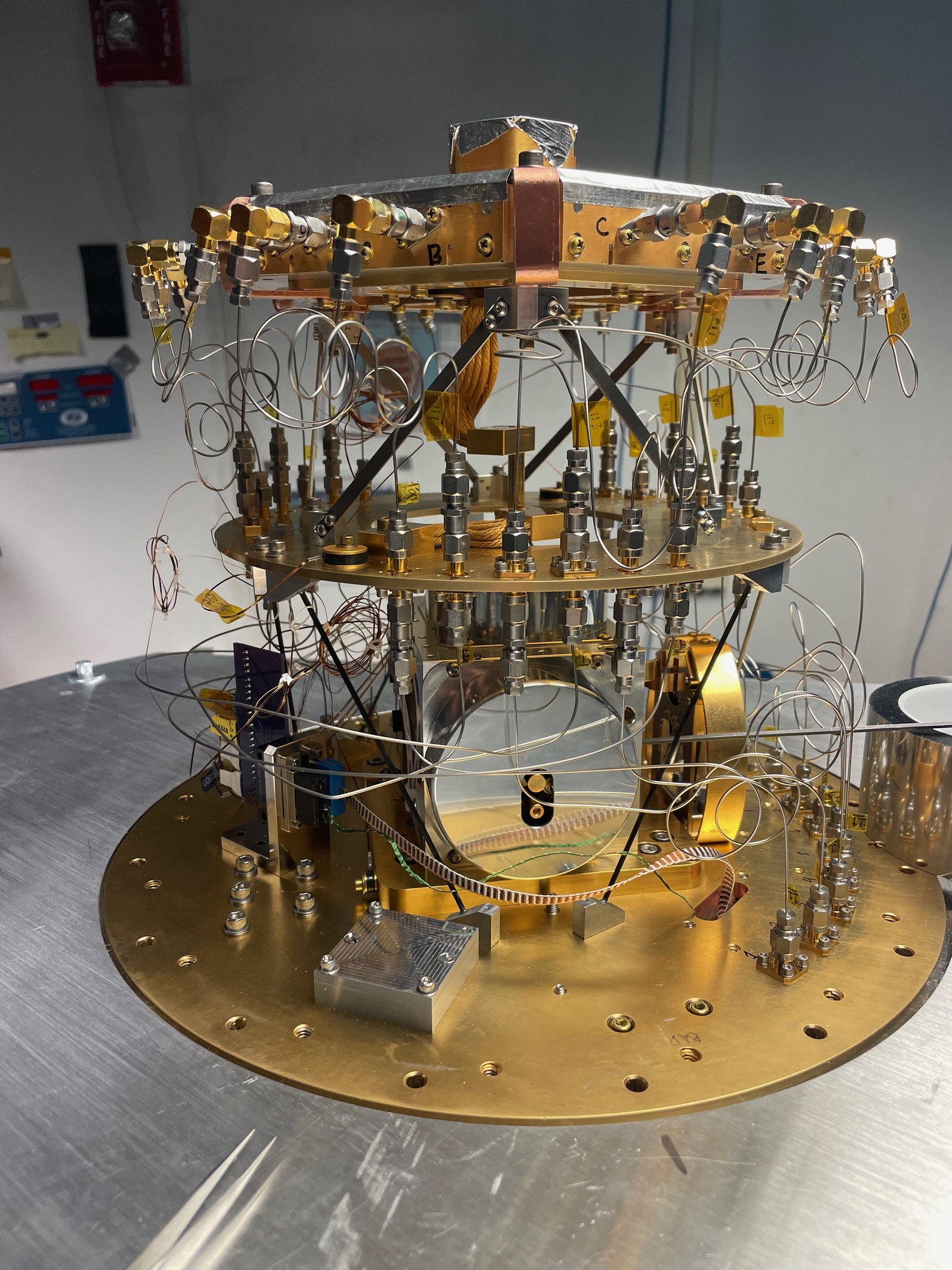
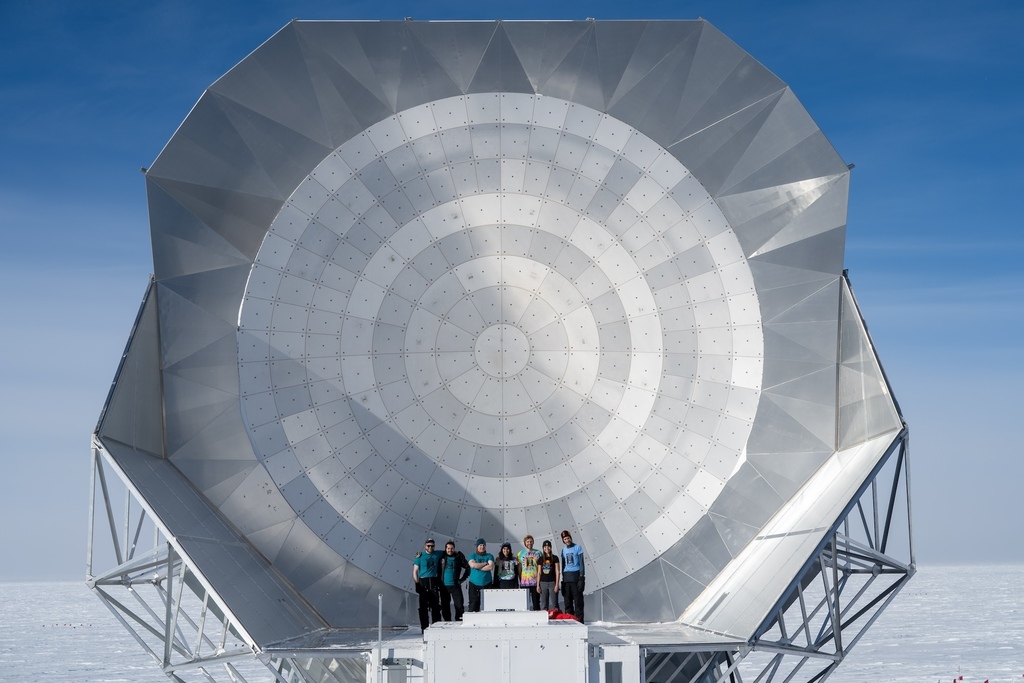
In 2021 our group started the SPT-SLIM (South Pole Telescope Shirokoff Line Intensity Mapper) project. SPT-SLIM is pioneering LIM measurements using on-chip mm-wave spectrometers, a new detector technology that dramatically improves sensitivity over traditional methods. We deployed our pathfinder instrument the South Pole Telescope for first-season observations in January 2025. Specific projects include:
- Spectrometer testing and bandpass characterization
- Analysis of on-sky data to constrain the power spectrum of high-redshift galaxies
- Forecasting to understand the science reach of LIM measurements