Research and publications
Fabrication of ophthalmic lenses by Fluidic Shaping
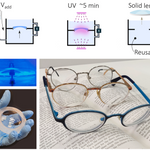 Limited access to corrective eyewear remains a significant medical, societal, and economic challenge in developing countries, with more than 1 billion people suffering from uncorrected vision impairment. Philanthropy has failed to meet the demand, and local manufacturing using standard technologies remains beyond reach due to inadequate resources. We present a fluidic approach, leveraging the surface tension of liquid polymers, with which high-quality solid lenses, with any prescription, can be created without machining, polishing or any post-processing steps. We provide an experimentally-validated analytical model relating the geometrical degrees of freedom to the desired prescription. Using a compact low-power device, we demonstrate that the fluidic approach allows the fabrication of industry-standard eyeglasses in several minutes, opening the door to advanced manufacturing in low-resource settings.
Diffraction of walking drops by a standing Faraday wave
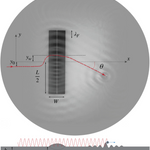 The Kapitza-Dirac effect is the diffraction of quantum particles by a standing wave of light. We here report an analogous phenomenon in pilot-wave hydrodynamics, wherein droplets walking across the surface of a vibrating liquid bath are deflected by a standing Faraday wave. We show that, in certain parameter regimes, the statistical distribution of the droplet deflection angles reveals a diffraction pattern reminiscent of that observed in the Kapitza-Dirac effect. Through experiments and simulations, we show that the diffraction pattern results from the complex interactions of the droplets with the standing wave. Our study highlights nonresonant effects associated with the detuning of the droplet bouncing and the bath vibration, which are shown to lead to drop speed variations and droplet sorting according to the droplet’s phase of impact. We discuss the similarities and differences between our hydrodynamic system and the discrete and continuum interpretations of the Kapitza-Dirac effect, and introduce the notion of ponderomotive effects in pilot-wave hydrodynamics.
Shaping a gallium alloy and an ionic liquid into spherical mirrors for future liquid-based telescopes
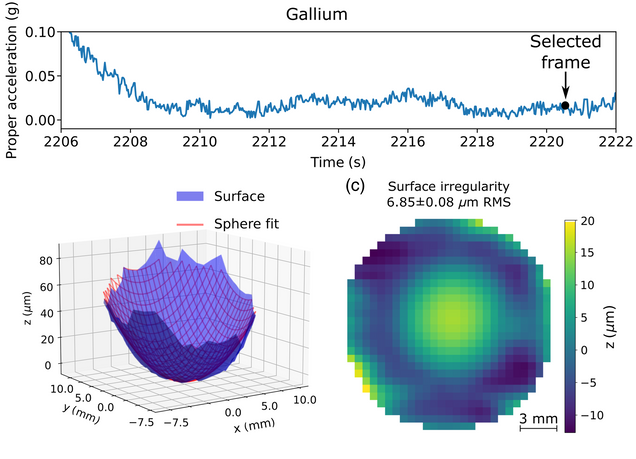 Space telescopes play a key role in the exploration of our universe, from imaging planets to gathering spectra of distant stars. To date, all space telescopes are manufactured on Earth and launched into orbit, with their size constrained by the diameter of the launcher’s payload fairing. This approach sets a hard limit on the telescope light collection ability, which determines its resolution and contrast. The Fluidic Telescope (FLUTE) project proposes to overcome launch constraints through the in-space creation of large liquid mirrors by utilizing interfacial physics under microgravity conditions. We present the design of experiments for the creation and measurement of spherical liquid mirrors under microgravity and their successful execution in parabolic flights. We describe the design of the mechanical apparatus and experimental methods used to pin, constrain, and control liquid gallium alloy and ionic liquid, as well as the optical technique used to reconstruct their surfaces in situ using Shack–Hartmann wavefront sensing. The results validate our experimental approach and show that the surfaces obtained under microgravity are indeed spherical, as expected from theory, though parabolic flight conditions prohibit optical-grade liquid surfaces. This set of experiments is a key milestone in maturing the FLUTE approach toward future extremely large liquid space telescopes.
Perspective on pilot-wave hydrodynamics
In our recent paper, we present a number of fresh perspectives on pilot-wave hydrodynamics that furnishes a classical framework for reproducing many quantum phenomena and allows one to rationalize such phenomena mechanistically, from a local realist perspective. We draw a distinction between hydrodynamic pilot-wave theory and its quantum counterparts, Bohmian mechanics, the Bohm–Vigier stochastic pilot-wave theory, and de Broglie’s theory of the double-solution. Each of these quantum predecessors provide a valuable touchstone as we take the physical picture engendered in the walking droplets and extend it into the quantum realm via theoretical modeling. We give emphasis to recent developments in the field, both experimental and conceptual, and to forecasting potentially fruitful new directions.
Elitzur-Vaidam bomb tester
 The Elitzur-Vaidman bomb tester is the most famous example of interaction-free measurement – a quantum phenomenon that seemingly allows particles to detect objects along paths they never traveled. Here, we present a classical analog of interaction-free measurement using the hydrodynamic pilot-wave system, in which a droplet self-propels across a vibrating fluid surface, guided by a wave of its own making. We argue that existing rationalizations of interaction-free quantum measurement in terms of particles being guided by waveforms allow for a classical description manifest in our hydrodynamic system, wherein the measurement is decidedly not interaction-free.
Fluidic shaping and in-situ measurement of liquid lenses in microgravity
In the absence of gravity, surface tension dominates over the behavior of liquids. While this often poses a challenge in adapting Earth-based technologies to space, it can also provide an opportunity for novel technologies that utilize its advantages. In this work, we present the design, implementation and analysis of parabolic flight experiments demonstrating the creation and in-situ measurement of optical lenses made entirely by shaping liquids in microgravity. We provide details of the two experimental systems designed to inject the precise amount of liquid within the short microgravity timeframe provided in a parabolic flight, while also measuring the resulting lens’ characteristics in real-time. We successfully created more than 20 liquid lenses during the flights and demonstrated the feasibility of creating and utilizing liquid-based optics in space.
Quasiperiodic Order-Disorder Transitions in Faraday Waves
 We present an experimental study of quasiperiodic transitions between a highly ordered square-lattice pattern and a disordered, defect-riddled state, in a circular Faraday system. We show that the transition is driven initially by a long-wave amplitude modulation instability, which excites the oscillatory transition phase instability, leading to the formation of dislocations in the Faraday lattice. The appearance of dislocations damps amplitude modulations, which prevents further defects from being created and allows the system to relax back to its ordered state. The process then repeats itself in a quasiperiodic manner. Our experiments reveal a surprising coupling between two distinct instabilities in the Faraday system, and suggest that such coupling may provide a generic mechanism for quasiperiodicity in nonlinear driven dissipative systems.
Hydrodynamic Analog of Superradiance
In quantum optics, there is an intriguing phenomenon known as superradiance wherein a collection of excited atoms exhibits cooperative, spontaneous emission of photons at a rate that exceeds that of the sum of its component parts. In this paper, we describe a similar phenomenon in a hydrodynamic system consisting of a pair of vibrationally-excited cavities, deep circular wells in a fluid bath, that are coupled through their common wavefiel.
Surreal Trajectories
 In certain instances, the particle paths predicted by Bohmian mechanics are thought to be at odds with classical intuition. A striking illustration arises in the interference experiments envisaged by Englert, Scully, Süssmann, and Walther, which lead the authors to claim that the Bohmian trajectories cannot be real and so must be “surreal.” Through a combined experimental and numerical study, we here demonstrate that individual trajectories in the hydrodynamic pilot-wave system exhibit the key features of their surreal Bohmian counterparts. These real surreal classical trajectories are rationalized in terms of the system’s non-Markovian pilot-wave dynamics. Our study thus makes clear that the designation of Bohmian trajectories as surreal is based on misconceptions concerning the limitations of classical dynamics and a lack of familiarity with pilot-wave hydrodynamics.
Marangoni Shaping of Liquid Films
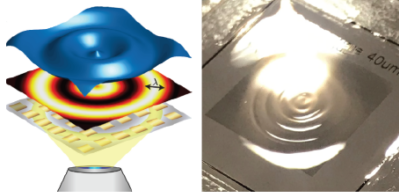 The ability to arbitrarily control the topography of a thin liquid film can be beneficial for a range of applications, from optics to biology. However, no methods exist today for achieving programmable surface deformations. In our work we show that photoactuation, achieved using a low intensity projection, can effectively drive thin film deformations via the thermocapillary effect. Our method enables rapid prototyping of diffractive optical elements – answering an unmet need in the optical design industry.
Fabrication of Freeform Optics by Fluidic Shaping
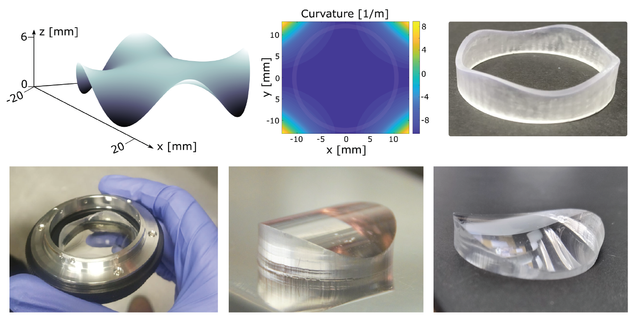 Freeform optical components enable advanced manipulation of light that is not possible with traditional optical systems. However, their fabrication relies on machining processes that are complex, time-consuming, and require significant infrastructure. Here we present the ability to shape liquid volumes and solidify them into desired freeform components, enabling rapid prototyping of freeform components with high surface quality. The method is based on controlling the minimum energy state of the interface between a curable optical liquid and an immersion liquid, by dictating a geometrical boundary constraint. We provide an analytical solution for the resulting topography given a predefined boundary and demonstrate the fabrication of freeform components with sub-nanometer surface roughness within minutes.
Fluidic Shaping of Optical Components
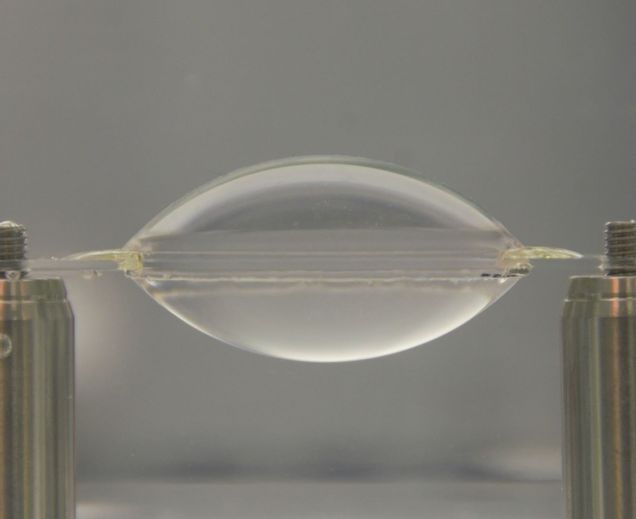 Current methods for fabricating lenses rely on mechanical processing of the lens or mould, such as grinding, machining and polishing. The complexity of these fabrication processes and the required specialized equipment prohibit rapid prototyping of optical components. Here we present a simple method, based on free-energy minimization of liquid volumes, which allows us to quickly shape curable liquids into a wide range of spherical and aspherical optical components, without the need for any mechanical processing. After the desired shape is obtained, the liquid can be cured to produce a solid object with nanometric surface quality.
Intermediate States of Wetting
on Hierarchical Superhydrophobic Surfaces
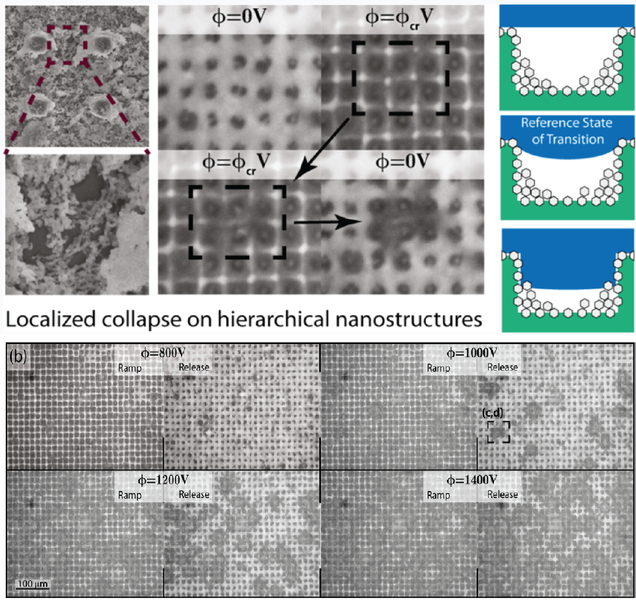 Wetting transition on superhydrophobic surfaces is commonly described as an abrupt jump between two stable states—either from Cassie to Wenzel for nonhierarchical surfaces or from Cassie to nano-Cassie on hierarchical surfaces. We here experimentally study the electrowetting of hierarchical superhydrophobic surfaces composed of multiple length scales by imaging the light reflections from the gas–liquid interface. We present the existence of a continuous set of intermediate states of wetting through which the gas–liquid interface transitions under a continuously increasing external forcing. This transition is partially reversible and is limited only by localized Cassie to Wenzel transitions at nanodefects in the structure. In addition, we show that even a surface containing many localized wetted regions can still exhibit extremely low contact angle hysteresis, thus remaining useful for many heat transfer and self-cleaning applications.
Dipolar Thermocapillary Motor and Swimmer
 The study of thermocapillary driven flows is typically restricted to “open” systems, i.e., ones where a liquid film is bounded on one side solely by another fluid. However, a large number of natural and engineered fluidic systems are composed of solid boundaries with only small open regions exposed to the surrounding. In this work we study the flow generated by the thermocapillary effect in a liquid film overlaid by a discontinuous solid surface. If the openings in the solid are subjected to a temperature gradient, the resulting thermocapillary flow will lead to a nonuniform pressure distribution in the film, driving flow in the rest of the system. For an infinite solid surface containing circular openings, we show that the resulting pressure distribution yields dipole flows which can be superposed to create complex flow patterns, and demonstrate how a confined dipole can act as a thermocapillary motor for driving fluids in closed microfluidic circuits. For a mobile, finite-size surface, we show that an inner temperature gradient, which can be activated by simple illumination, results in the propulsion of the surface, creating a thermocapillary surface swimmer.
Thermocapillary flow of a thin liquid film in a confined two-layer system under a hydrophobic plate
We investigate flow in a thin liquid film over a heated solid surface in a bilayer two-dimensional gas-liquid system bounded on the gas side by an isothermal hydrophobic plate. The flow is driven by the Marangoni instability induced, in one case, by a thermal wave propagating along a flat solid substrate on the liquid side and in the other case by a left-right asymmetric topography of the thick solid substrate adjacent to the liquid phase uniformly heated at its outer surface. We demonstrate that the presence of a hydrophobic substrate enables a continuous flow for narrow systems associated with low values of the ratio between the mean thickness of the gas layer to that of the liquid, which would be impossible in its absence. This represents an extension of the conceptual methods discussed in our previous studies for the control and amplification of the average flow rate through the system for narrow systems, thus allowing for efficient thermocapillary transport in extremely small microfluidic devices.
Liquid film flow along a substrate with an asymmetric topography sustained by the thermocapillary effect
We investigate flow in a thin liquid film over a “thick” asymmetric corrugated surface in a gas-liquid bi-layer system. Using long-wave approximation, we derive a nonlinear evolution equation for the spatiotemporal dynamics of the liquid-gas interface over the corrugated topography. A closed-form expression indicating a non-zero value for a liquid flow rate is derived in a steady state of the system. Through numerical investigations we study the nonlinear dynamics of the liquid-gas interface with respect to topographical variations of the solid surface, different thermal properties of the liquid and the solid, and different values of the Marangoni number. We find the existence of a critical value for the Marangoni number Mc, so that for M > Mc, the liquid film ruptures, whereas for M < Mc, the interface will remain continuous. In a broad variety of parameters, the interface attains a deformed steady state with a nonzero average flow rate through the system, thus the described mechanism may be used as a means of transport in microfluidic devices. We carry out the Floquet stability analysis of periodic steady states with respect to spatial replication and show that in the framework of the time-independent evolution equation, the system is unstable to long wave perturbations. We demonstrate that in a finite periodic setting, the system may evolve within a certain parameter range into a metastable state which may be manipulated by varying the Marangoni number M in time in order to increase, control, and sustain the average flow rate through the system. We also show that in the case of a solid substrate with the thermal conductivity lower than that of the liquid, the flow rate through the system may be significantly increased with respect to the opposite case.
Creating localized droplet train by traveling thermal waves
We investigate the nonlinear dynamics of a two-layer system consisting of a thin liquid film and an overlying gas layer driven by the Marangoni instability induced by thermal waves propagating along the solid substrate. In the case of a stationary thermal wave with sufficiently large amplitude and Marangoni number, liquid film rupture takes place with a flattish wide trough. For sufficiently small but not too small frequencies of the thermal wave, a periodic structure consisting of localized drops interconnected by thin liquid bridges emerges. This train of drops travels unidirectionally along the heated substrate following the thermal wave. For larger thermal wave frequencies, the thickness of the bridges increases enabling fluid flow between the neighboring drops. The drop-train regimes may be utilized in microfluidic applications for directed transport of liquid content enclosed in drops formed by thermocapillary forces.