Registration Guide: Mathematics & Computer Science
Students majoring in Mathematics & Computer Science will ordinarily, through coursework in the major, satisfy BU Hub requirements in Quantitative Reasoning and some elements of the Intellectual Toolkit. Remaining BU Hub requirements will be satisfied by selecting from a wide range of available courses outside the major or, in some cases, cocurricular experiences.
A typical first semester Mathematics & Computer Science schedule looks like:
- Calculus course
- Computer Science course
- Language course or Course of interest
- Writing course
- Optional add-on: First-Year Seminar
Please see below for more detailed suggestions on each course:
Course #1: Calculus Course
As a Mathematics & Computer Science major, you should take a calculus course in your first semester:
- If you have no external credit for calculus, take CAS MA 123 Calculus 1.
- If you have advanced credit (such as AP or IB scores) that fulfills CAS MA 123, take the next course in the sequence, CAS MA 124 Calculus 2.
- If you have already fulfilled both CAS MA 123 and CAS MA 124, you should take the final course in the sequence, CAS MA 225 Multivariate Calculus.
- If you have potential advanced credit in calculus, but don’t have the scores back yet, register with cautious optimism. If you feel confident you did well on the exams, register as if you will receive the corresponding credit. Once you know your scores, you can revise your schedule, if need be.
Course #2: Computer Science Course
For your second course, you should choose the appropriate level computer science course based on any advanced credit you already have:
- If you have no advanced credit for computer science, you should register for CAS CS 111 Introduction to Computer Science 1. This course is a rigorous introduction that develops computational problem-solving skills by programming in the Python language, and exposes students to a variety of other topics from computer science and its applications.
- If you have advanced credit for CAS CS 111 you should instead register for CAS CS 112 Introduction to Computer Science 2.
- If you have advanced credit for CAS CS 111 and CS 112, you should register for CAS CS 131 Combinatoric Structures or CAS MA 293 Discrete Math. You should take one of these courses, but not both.
Course #3: Language Course or Course of Interest
CAS Language Course: CAS students must exhibit proficiency through the fourth-semester level of a language other than English. If you have not already done so, please review the full language policy here.
If you plan to fulfill this language requirement through coursework at BU, then your next course should be a language course:
- If you’re new to the language, you’ll start with the first-semester level (usually coded as 111 – for example, Spanish 1 is CAS LS 111, Arabic 1 is CAS LY 111, etc.).
- If you have previously studied the language, you will need to take a placement test to determine what level to start with (for instance, CAS LS 112 Spanish 2, CAS LY 211 Arabic 3, CAS LK 212 Korean 4, etc.). Please review the CAS Language Requirement page for detailed information about placement tests and appropriate levels.
If you’ll fulfill the language requirement through advanced credit (such as AP/IB scores) or through native proficiency of another language, you have fulfilled your language requirement and can instead take a course of interest (as seen below).
-OR-
Course of Interest: Select a course that interests you – perhaps based on subjects you’ve enjoyed in the past or a new subject you’re excited to try for the first time! If you’re not sure where to start, you can review our Registration Instructions for tips on browsing by topic or Hub requirement.
- Please note: if you’re interested in taking a statistics course, DO NOT take CAS MA 113, CAS MA 115 or CAS MA 116, as these will not count towards math-based major requirements. Instead, you should take CAS MA 213 Basic Statistics and Probability (offered either semester), which can count towards your major.
- If you wish to take a statistics course and already have advanced credit for CAS MA 115 Statistics 1, you will likely want to forfeit this and take CAS MA 213 instead. Although MA 115 and MA 213 count for duplicate credit, it is rarely recommended that a student jump from MA 115 to CAS MA 214 Applied Statistics, which counts for Statistics 2 for math-based majors. MA 213 and MA 214 move at a much faster pace and include more content than the CAS MA 115 equivalent.
- If taken at BU, CAS MA 213 and CAS MA 214 both fulfill a single requirement in each of the following BU Hub areas: Quantitative Reasoning II and Teamwork/Collaboration.
Course #4: Writing Course
Your fourth course should be a writing course:
- If you did not apply to BU with a TOEFL/IELTS score, you can take either:
- CAS WR 120 First-Year Writing Seminar. Each section of WR 120 focuses on a specific topic/theme, so you should register for a section that pairs with your interests.
- CAS CC 101 Core Humanities 1: Ancient Worlds: (offered Fall only): An interdisciplinary study of the origins of civilization, from Mesopotamia and the Hebrew Bible to the development of Greek civilization through Homer, Greek tragedy, and the philosophy of Plato. You should enroll in CAS CC 101 if you are considering the Core Curriculum. This course fulfills a single requirement in each of the following Hub areas: Aesthetic Exploration, First-Year Writing Seminar, Creativity/Innovation.
- If you applied to BU with a TOEFL/IELTS score, you should take the Multilingual Writer Placement (instructions will be sent via email) before you register for a writing course. The writing placement is a suggestion, but it will help you make an informed decision about the most appropriate level for you. Depending on what level WR course you register for, you will fulfill the following Hub requirements:
- CAS WR 111 Academic Writing for ESL Students 1 – fulfills The Individual in Community Hub
- CAS WR 112 Academic Writing for ESL Students 2 – Global Citizenship & Intercultural Literacy Hub
- CAS WR 120 First-Year Writing Seminar – fulfills First-Year Writing Seminar Hub (If you place into WR 120, you are welcome to take CC 101 Core Humanities 1 instead to fulfill your FYW Hub.)
Optional Course #5: First-Year Seminar
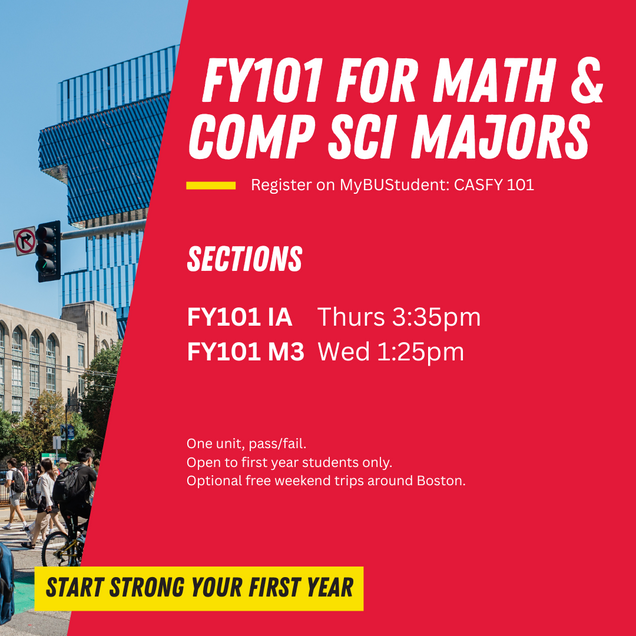
First-Year Seminar: FY 101 (1 unit) – Optional
FY101 is a one-unit, low stress, non-academic class that serves as a semester-long introduction to BU and college life. FY101 helps you get a head start on making connections at BU. Each section is taught by a student peer mentor and a staff instructor.
- FY101 classes are small and are for new students only, so they provide a great way to get to know other first-years!
- Your peer mentor and instructor will provide resources to create a more successful and meaningful college experience and help you get ahead in your first semester here.
- FY101 includes free, optional trips around Boston.
- There are specialty sections based on major and identity (e.g., Undeclared, Natural Sciences, First Generation, etc ) so be sure to choose the one that’s right for you!
-OR-
First-Year Career Development Seminar: FY 102 (offered spring only, 1 unit) – Optional
FY102 will help first-year students get started on utilizing the Career Development Cycle to maximize their time at BU. During this course, students will create a plan of action towards choosing a major, creating a resume, finding an internship, and preparing for a career they will love. Seminars are offered in various fields of interest and include guest speakers from different industries.
Interested in Pursuing the Core?
If you are interested in the Core Curriculum, we recommend one of the following courses in place of a language course/course of interest. (Talk to your advisor to discuss these adjustments in more detail!)
- CAS CC 111: Core Natural Science 1: Origins—of the Big Bang, Earth, Life and Humanity (offered fall only): The origins of the physical world, a scientific parallel to CC 101. Explores how the fields of astronomy, earth science, biology, and anthropology help us to understand our place in the cosmos from a scientific perspective. Topics include the Big Bang, evolution of the stars and earth, evolution of life, and the origins of human life and society. Assignments include computer-based and experimental laboratory work as well as team-based investigation and original research.
- This course fulfills a single requirement in each of the following Hub areas: Scientific Inquiry I, Quantitative Reasoning I, Teamwork/Collaboration.
- This course will fulfill the CAS Natural Sciences Laboratory requirement.
- CAS CC 212: Core Natural Science 2: Reality, Science, and the Modern World (offered spring only): Studies the paradigm-shifting scientific theories of quantum theory and relativity that created a new world view and forced the 20th century into a new understanding of our relation to reality. Students parallel these theories with current debates about science, such as those concerning climate change and the phenomenon of “junk science.” Considers the role of science in the modern world, how we know what we know, the roles of Heisenberg’s Uncertainty Principle and chaos theory, and the nature of truth in a 21st century context.
- This course fulfills a single requirement in each of the following Hub areas: Scientific Inquiry II, Quantitative Reasoning II, Critical Thinking.
- This course will fulfill the CAS Natural Sciences Laboratory requirement.
If you are interested in the humanities-based Core courses, we encourage you to consider CAS CC 101 (see the ‘Writing Course’ drop-down above).
**PLEASE NOTE: Students in the Core Program who are interested in majors within the natural sciences (Astronomy, Biology, Chemistry, Earth & Environmental Sciences, Neuroscience, Physics, etc.) and are taking at least one laboratory course this semester should NOT enroll in CAS CC 111 or 212.
Find out more about the Core Curriculum, the Hub, and registration here.
Ready to register? Let’s go – click here!
For more information about your specific major requirements click here!